
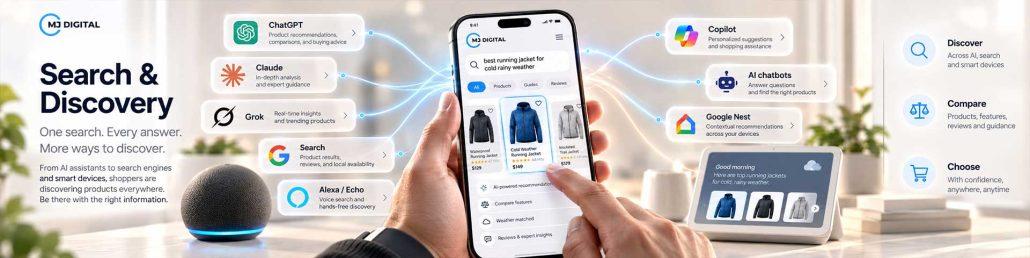
What if your next customer decides which product to buy after never having visited your website? They might ask an AI-assistant through Claude, GPT, Grok or Google to find answers, discover the options, compare products, ask recommendations, and then arrive at your online store or local business already knowing what they want. Yet majority of businesses and large enterprises still manage SEO, website search, PIM and product data, MarTech and customer data as separate siloed functions. Customers don't see those silos. They simply want to find the right product and make a confident choice. Search & Discovery is no longer just about being found. It's about being understood, considered and chosen—wherever customer decisions happen.
In my earlier article, AEO, GEO, and SEO: Why Search Is Becoming a Visibility Strategy, I explored how AI is changing where customers discover brands and why visibility, authority and trust now matter beyond traditional search rankings.
But being discovered is only the beginning.
The bigger opportunity is connecting what customers are looking for with the products, content and experiences that help them make confident decisions.
That requires more than SEO or another AI tool. It requires Digital, Product, eCommerce, MarTech and Data teams to connect customer intent, product intelligence and technology across the entire discovery journey.
The question for business leaders is no longer just how customers find us. It’s whether our digital ecosystem works together well enough to surface the brand or products wherever the customer searches for answers and recommendations, help them choose—and make it measurable to understand the business value.
1. The Customer Journey Is Changing Faster Than the Organization
Search used to have clearer boundaries. SEO brought customers to the website. Onsite user experience helped them browse, search and find products. MarTech personalized recommendation and messages. Merchandising influenced what appears now, next and later.
Today, a customer looking for running apparel suitable for cold, rainy conditions may begin with Google, ask ChatGPT for comparisons, explore a retailer’s app and finish in-store.
Their question reveals more than keywords. It carries intent: activity, climate, location, comfort, fit, availability, budget and product preferences.
Answering it well requires customer insight, product information, search relevance, content, inventory and technology working together.
Increasingly, AI tools and platforms may influence which brands or products customers consider before they reach an owned channel.
And this is today. Tomorrow, we might expected the brand or production recommendation, or answer, influenced from a pay-to-play advertising model.
But until then, the former creates a commercial risk and what you do today will provide the foundation for a tomorrow pay-to-play or hybrid discovery model.
While I have no crystal ball, I anticipate businesses will face new costs, weaker attribution and greater dependence on intermediaries controlling the discovery experience over the next few years (if not sooner).
The leadership challenge is protecting customer relevance and brand influence, even when another platform controls the interface.
2. Turn Search Into Customer and Product Intelligence
Every failed search, repeated question, selected filter and abandoned product journey contains insight.
Are customers using language our taxonomy doesn’t recognize? Looking for features our product data doesn’t describe? Searching for products our assortment doesn’t offer or serves up an empty result?
I’ve seen businesses treat these primarily as search and content optimization problems.
I believe that’s too narrow.
A zero-result search may expose missing attributes and missing intent signals. Repeated demand for weather-specific apparel may reveal an assortment opportunity. Budget or financing methods may surface how customers are responding to the market conditions with tighter spending or preferences for more flexible financing options.
Whatever the driver behind a customers intent, these emerging questions may influence product development, marketing messaging or personalization considerations, content creation or merchandising signals.
A value-gap in an organization I see far too often is the lack of understanding that the value of search intelligence extends well beyond the Search team or your SEO agency.
Product can use it to prioritize the roadmap.
Merchandising can identify unmet demand.
Marketing can improve relevance.
MarTech can activate intent signals across personalized experiences.
Search shouldn’t only help customers find what you sell. It should help the business understand what customers need, what you may need to offer next and keep your brand top-of-mind by simply providing the right answer to their question whether they buy or not.
3. Product Intelligence Is Becoming Commercial Infrastructure
How do you manage your product content today for Marketing?
I’ve seen some businesses stretch their IMS (inventory management system) to power their Shopify stores, but this can come with major limitations?
Why? Most IMS were originally built and implemented to manage the back-end details of inventory management, and physical logistics.
And while many IMS have delivered feature improvements in their roadmaps, they eventually plateau and a handoff is needed to a better solution; such as a PIM.
Other more mature brands however have adopted a PIM (product information management) to manage their customer-facing marketing data. This leaves a cleaner line between what their IMS should do, versus its integrated hand-off to a PIM.
In either case, where both an IMS and PIMs were integrated with a retailers eCommerce store, the broader Search and Discovery needs were missed and AI has exposed those gaps.
Whatever PIM or inventory management tool you use today, AI-powered discovery depends on accurate, structured and trusted product knowledge.
For apparel, that includes fit, fabric, colour, intended activity, weather suitability, sizing, reviews, inventory and availability.
These aren’t simply catalogue fields anymore. They influence whether products can be understood, compared, recommended and purchased across search engines, AI assistants, marketplaces, websites, apps and whatever the future holds (think Optimus robots).
A good example of this is earlier this year Nike made the announcement with Google, plans to bring product discovery and purchasing into Gemini and Google AI Mode through Google’s commerce capabilities.
That matters because A) customers may increasingly discover and transact through interfaces brands don’t own, and B) enhancing the personalized shopping experience in the digital ecosystem brands do own, has become increasingly more crucial.
The business requirement is bigger than submitting another product feed. Product information must remain accurate, consistent, current and accessible through supported channels.
That includes trustworthy claims, ratings and reviews, pricing, customer feedback, inventory and clear data ownership.
Nike’s announcement illustrates the direction of the market, although it did not establish incremental revenue attributable to the initiative.
Product data is becoming part of how brands compete for customer consideration—not just how they manage an online catalogue.
4. Connect MarTech, Commerce and Customer Intent
Many enterprises already have substantial digital investments: commerce platforms, CDPs, CRM, product information systems, search technology, CMS, analytics, marketing automation and AI.
The problem often isn’t a lack of tools. It’s that the tools don’t act together when customers need them.
Imagine someone searching for winter running apparel.
Their query reveals immediate intent. Product information identifies suitable items. Inventory confirms available sizes. Commerce provides pricing and delivery options. MarTech can apply permitted preferences or audience signals, while decisioning technology selects relevant recommendations and content.
The result is a more useful shopping experience—not simply another personalized message.
Importantly, it doesn’t always require knowing who the customer is.
**An anonymous visitor’s immediate intent can be more useful than a rich customer profile that’s unrelated to their current need.**
This changes how I think about MarTech value: start with the customer decision, identify the data and capabilities needed, and activate the experience.
That also means managing practical constraints: consent, privacy, outdated data, integration delays and conflicting sources of truth.
An AI recommendation for an unavailable product or an inaccurate delivery promise is not a better experience. It’s a broken one.
**The goal isn’t to connect every system before starting. It’s to connect the right intelligence to the right customer moment—and deliver on the promise.**
5. The Business Value Is Already Emerging
To bring this shift to life, let’s look at three leading retailers that are already adapting to how customers search, discover and choose products. Each offers a different perspective on the evolution—and the value it can create.
JD Sports — Make Existing Discovery Perform Better
In its September 2026 announcement with Algolia, JD Sports reported a 22% increase in revenue from search and a 73% increase in product-listing page click-through rates following search modernization that began in 2024.
The retailer also reported less manual merchandising work and is extending its discovery capabilities toward AI-assisted shopping.
Keep in mind these are vendor-reported implementation outcomes, not proof that agentic AI itself created the gains.
The lesson: Before funding a new AI shopping experience, understand how much value you’re leaving behind in today’s search relevance, product data and merchandising processes.
Walmart — Connect Discovery to the Full Customer Experience
Now take Walmart’s February 2026 earnings call (pdf), Walmart reported approximately 35% higher average order values (AOV) among customers using its Sparky AI shopping assistant than among non-users.
That difference doesn’t establish that Sparky caused the increase.
More importantly, Walmart described how Sparky connects shopping intent to inventory, pickup, delivery and stores.
The lesson: Product discovery only creates a trusted experience when the business can fulfil what it recommends.
Amazon — Show the Commercial Potential of AI Discovery
In Amazon’s February 2026 annual results announcement, Amazon reported that more than 300 million customers had used Rufus (now rebranded to Alexa for Shopping), its AI shopping assistant, and attributed nearly $12 billion in incremental (extra sales) annualized sales to the capability during 2025.
These are Amazon-reported figures, but they illustrate why conversational product discovery deserves attention beyond experimentation.
The lesson isn’t to copy Alexa for Shopping. It’s to identify where AI can materially reduce decision friction, and demonstrate commercial value.
Across all three examples, the common opportunity is clear:
Connect intent, trusted product intelligence and commerce execution before expecting AI to transform the customer experience.
6. One Customer Journey Needs Shared Leadership
This is where even well-funded transformations can stall.
Product owns the roadmap.
MarTech manages activation.
Merchandising influences ranking and assortment.
Data and Technology support the foundations.
Search works on relevance and discoverability.
But who owns the outcome across the entire journey? Everyone – and this is why there an alignment on goals and priorities cannot be understated.
I’ve seen how quickly enterprises become fragmented when teams work toward different priorities, different measuring sticks and different views on what success looks like.
I believe the answer isn’t necessarily a new department. It’s shared accountability, clear decision rights, a quarterly roadmap calibration conversation, and a common commercial North Star.
For example, should search ranking favour the most relevant product, available inventory, higher margin or a new launch?
Those priorities may compete. Leaders need agreed principles, customer evidence and a way to measure the trade-offs.
The same applies to investment.
Would fixing product attributes and zero-result searches create more value than launching a conversational AI assistant? What’s the expected customer impact, commercial return, delivery effort and ability to reuse the capability and rise-the-tide of other global teams?
I would prioritize investments through five lenses: customer friction, commercial opportunity, repurpose across channels and markets, speed to value, and risk.
For global enterprises, the operating model also needs balance. Standardize shared data, governance and technology foundations, while allowing regions to adapt language, assortment, seasonality and customer experiences.
One discovery foundation. Many locally relevant experiences.
7. Measure Better Decisions, Not Just More Discovery Activity
SEO rankings, organic traffic, AI visibility, search click-through rates and engagement still matter.
But they aren’t the ultimate business outcomes but are all leading indicators to the answers you seek.
The real questions are whether customers find suitable products, make confident decisions and create incremental commercial value.
That means measuring search success, zero-result rates, reformulations, product engagement, conversion, availability-related friction, attributed revenue, returns and contribution margin.
Where possible, run controlled experiments to separate genuine improvement from demand that would have converted anyway.
And as AI assistants as CoPilot, Claude, GPT and others influence consideration without always delivering a website visit, businesses will need new ways to monitor brand visibility (ex. Profound, Adobe Brand Visibility, Peec AI, semrush enterprise, etc.) product accuracy and recommendation quality—without pretending that every citation or mention equals revenue.
The simple takeaway; measure what discovery changes for the customer and the business, not simply how often the system gets used.
8. Five Questions I’d Take Into the Next Meeting
The future of Search & Discovery isn’t something we need to wait for.
I’d begin with five practical questions:
- Where are customers discovering and comparing our products today?
Test real shopping questions across Google, Grok, ChatGPT, Gemini, Copilot and your own search experience. Are our products visible, accurately represented and relevant? - Can AI shopping platforms access and understand our product information?
Review product attributes, structured data, feeds, supported merchant integrations, pricing, availability, reviews and update processes. - What unmet needs is our search data revealing?
Bring zero-result searches, repeated queries and abandoned journeys to Product, Merchandising and Marketing—not just the Search and content team. - Can our existing tools and tech activate customer intent?
Choose one high-value use case connecting search, product information, commerce, inventory and MarTech. Test relevance for anonymous and known customers within privacy requirements. - What should we fix, connect or test next? Agree on one accountable owner, a customer outcome, an expected commercial benefit and the evidence required to expand or stop the investment.
I might even add in a sixth.
What could we do with Search or AI that would genuinely change the customer experience?
Bring together internal subject matter experts across Product, Digital, MarTech, Merchandising and Customer Experience. Ask: “Wouldn’t it be incredible if we could _____?”
Explore unmet customer needs, ideas that existing systems can’t yet deliver and opportunities to remove friction or create entirely new experiences.
The goal isn’t to launch another AI project.
It’s to uncover ideas worth testing and make calculated strategic bets.
AI is evolving rapidly, and there will be uncharted territory ahead. Leaders need to balance experimentation with sound judgment, knowing when to act, learn and adapt to create meaningful customer value and new business growth.
A useful starting exercise is to select five real customer questions and compare how well your website, app and external AI experiences answer them.
Identify the biggest gaps. Then choose one measurable improvement to deliver or test within 30 days.
The Next Competitive Advantage Is Being Chosen
Search & Discovery is no longer simply about SEO’ing a website, driving traffic or helping customers find products.
It’s becoming a connected growth capability across your digital ecosystem that adopts data across systems, helps businesses understand customer intent, influence decisions, deliver more relevant experiences and uncover new opportunities.
For Digital leaders, it’s about getting in front of your customer, strengthening the brands visibility and influence wherever customers discover and evaluate products.
For Marketing, Product and eCommerce, it’s turning customer signals into better experiences, smarter roadmap decisions and stronger conversion.
And for Data and MarTech, it’s connecting data, technology and existing investments to activate to customer channels to orchestrate meaningful customer experiences.
I believe the businesses that lead won’t be those with the most AI tools. They’ll be the ones that understand data is an asset and are giving the space to connect customer intelligence, product knowledge, technology and people to create experiences customers value—and turn those capabilities into measurable business growth and value.
Because the next competitive advantage isn’t just being found or bragging that you’re ranked #1 on the SERPs. It’s being understood, considered and chosen.
And that’s where the conversation gets interesting.
Are you exploring how Search, AI, Product and MarTech can work better together? Have an idea worth pressure-testing, a discovery challenge to solve or a digital investment that could deliver more?
I’m always open to exchanging perspectives, bouncing around ideas or being a sounding board. Whether you’re looking for a fresh perspective or help turning opportunities into practical plans and measurable results, I’d welcome the conversation.