
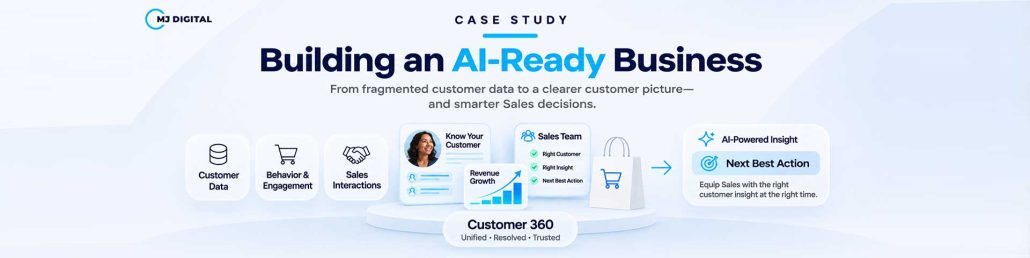
Every business wants AI to drive growth. But what happens when the business doesn't have a reliable trust of its own data, let alone a trusted view of its own customers?
And what happens next, when customers stop searching through websites and start asking AI assistants what to research, compare, which brands to trust and where to buy?
Getting AI-ready isn't about setting up an AI Chat bot or buying more AI tools. Fundamentally its about connecting the data, decisions and systems that make AI useful.
That's where this project began.
Executive Snapshot
How I modernized Sales and Marketing through connected customer data, buying signals and AI decisioning to support smarter Sales and Marketing, enable more relevant and hyper-personalized customer experiences and lay the foundation for the next generation of AI-powered and agentic commerce.
Client: Enterprise retail organization serving B2B and B2C customers.
Project focus: Modern marketing-driven for AI readiness, first-party data integration, identity resolution, Customer 360 and AI-driven uses-cases for next-best-action decisioning.
Business challenge: Siloed, fragmented, duplicated customer data and zero buying signals across Sales, Marketing, CRM and eCommerce systems limited customer intelligence, confidence business decisions and AI readiness.
Solution: A connected Customer 360 and AI decisioning architecture that turns anonymous and known customer behaviour into actionable intelligence, Sales priorities and recommendations to influence customers next best action.
Primary goal: Mature Marketing to make data useful for activation across teams and customers. Improve KYC (know your customer) or customer identification, Sales process improvements, effectiveness and revenue opportunities while establishing a reusable foundation for full lifecycle customer engagement, personalization and readiness for future AI capabilities.
My role: Led the project from business strategy and solution concept through architecture, MVP build and implementation and use-case activation, connecting business priorities, technology and execution.
Enablement: New Capabilities
Customer Identity Resolution Solution Developed & Tested
Built and tested an initial identity resolution model to match and connect fragmented customer records across systems, using exact, probability-based and AI-assisted matching methods.2. Customer 360 Foundation Established
Connected anonymous website behaviour with known customer identities to create richer, unified first-party customer profiles—improving customer visibility, understanding of customer needs (Know Your Customer) and buying-intent insights.3. AI Next-Best-Action MVP Developed
Established an initial AI decisioning capability to turn customer data into connected customer intelligence to deliver prioritized Sales opportunities and recommended actions, with a foundation for future Sales, Marketing and Agentic use cases.
Performance Measures
The MVP also established a foundation for measuring business impact as adoption grew. The results reflect client-approved performance at the time of measurement. Actual results may have since changed, and KPIs may have evolved as the solution matured.
- +45% — Attributed improvement in anonymous-visitor-to-known-contact conversion rate from initial baselines.
- From days to minutes — Reduction in time spent researching and prioritizing Sales opportunities.
- +24% to +80% — Improvement in SDR speed-to-lead qualification time and BRD conversion rate lift of breaking through conversations from highly personalized outreach.
Executive Summary
The business wanted to use AI to grow revenue and better serve customers, but its customer information was scattered across disconnected systems.
I led a focused project to connect that data, test how customer records could be matched and build the first Customer 360. We then developed an AI decisioning MVP designed to spot buying signals and recommend what Sales should do next.
The project also explored a shared, governed AI foundation that could make future use cases faster and easier to launch.
The result: a practical starting point for turning disconnected data into useful customer intelligence and business action.
The Challenge
AI Ambition, Disconnected Data
Every business wants AI to drive growth. But what happens when the business doesn’t have a reliable view of its own data and customers?
That was the challenge.
The business had valuable information across CRM, eCommerce, Marketing, Sales and product systems. But much of it was fragmented, duplicated or disconnected.
CRM held customer and account records. eCommerce captured browsing behaviour and product interests. Marketing platforms tracked campaigns and engagement. Sales systems contained opportunity history and customer relationships.
The information existed, but the business struggled to connect the pieces into a useful customer picture.
It was difficult to answer seemingly simple questions:
Who is this customer? What are they interested in? Are they showing buying intent? Have they already engaged with Sales? And what should the business do next?
Adding another AI tool wouldn’t solve those problems. The business first needed to connect the information it already had.
Think of It Like Building with LEGO
Imagine a child’s bedroom with LEGO pieces scattered everywhere. Some are under the bed, others are hidden in drawers, a few are duplicates, and some are missing.
The child has a great idea for what to build but spends more time finding the right pieces than building anything.
That’s what fragmented customer data looks like.
The LEGO pieces are the customer data and information spread across business systems. The data architecture helps organize and connect those pieces so they can be used together.
The pieces were largely there. What was missing was a reliable way to put them to work.
The Strategy: From Customer Data to Intelligent Action
I led a practical four-step approach, keeping it lean, agile and focused on testing and learning. This helped build business confidence while turning fragmented customer data into useful intelligence and real business action.
Rather than trying to fix everything at once, we started with a focused proof of concept (POC) and evolved it into a minimum viable product (MVP) built around priority business use cases.
1. Get the data in order
Connect the data sources needed for the first use cases, improve data quality and address duplicate or disconnected records. With information scattered across different systems, we focused on building reliable data pipelines and getting the right data ready before expanding.
2. Build and test the first Customer 360
Capture anonymous website behaviour across the website, eCommerce and SaaS customer portal, product and feature interests and buying signals. As visitors become known, connect their eligible activity to customer records.
Design, build and test an initial identity resolution model using exact matching, probability-based matching and AI-assisted methods to identify and connect related records across CRM, Sales, Marketing, transactions and product systems.
The goal: bring fragmented information together into a more complete, reliable customer picture—helping the business better understand who its customers are, what interests them and where opportunities may exist.
3. Build and test the AI intelligence engine
Start with a focused POC to explore an AI agent harness, recommendation models, governance controls and feedback loops.
The first business use case focused on next-best-action decisioning—an intelligence engine designed to analyze customer signals, identify opportunities and recommend what Sales should do next.
But the client saw a bigger opportunity. Beyond a single recommendation engine, we wanted to explore a reusable AI foundation where future agents and business use cases could be added faster, with shared security, policies, oversight and tools rather than building everything from scratch each time.
4. Put intelligence to work
Turn recommendations into actions people can use. The first focus was helping Sales teams identify and prioritize sales opportunities within their existing workflows.
The approach also considered how to capture feedback on recommendations and their outcomes, helping the business learn and improve over time. Future use cases could extend the same intelligence into personalized website experiences, Marketing campaigns, automated customer journeys and likely not to far out in the distant future, and an aspirational BHAG–support conversational AI through connected devices.
The objective wasn’t to build another isolated database, recommendation engine or AI tool.
It was to create a connected, reusable foundation that turns customer data into smarter decisions and real business action—starting small, proving value and building the governance, speed and flexibility needed to scale AI across the business.
The Solution
From Anonymous Visitors to Known Customers
One of the first opportunities was understanding what future customers (leads) and existing customers were doing online before they identified themselves.
The solution captured eligible first-party digital activity, including website browsing, product interests and high-value engagement signals.
When a visitor became known through an appropriate identification event, their eligible activity could be connected to an existing or new customer record.
This helped bridge a common gap between digital browsing and shopping behaviour and customer information held in CRM and other business systems.
For example, Sales teams could gain insight into what customers were exploring online before they contacted the business—or even if they never reached out—for Sales executive outreach and more meaningful conversations.
Yes, it might sound a little “Big Brother,” but the goal wasn’t to watch customers. It was to better understand their needs, recognize buying signals and deliver more relevant, timely experiences—using first-party data responsibly, with appropriate privacy controls and permissions.
The real value wasn’t simply knowing that someone visited a website.
It was understanding what their activity might mean when combined with the broader customer relationship.
Identity Resolution: Connecting the Pieces
Capturing digital behaviour was only part of the challenge.
The business also needed a way to recognize when records across different systems referred to the same customer or account.
We developed and tested an initial identity resolution model using deterministic matching, fuzzy matching, probabilistic methods and AI-assisted techniques.
In simple terms, the model helped answer:
Do these different records belong to the same contact or customer?
Exact matching helped connect records using reliable shared identifiers (ex. think email address). Fuzzy matching helped identify data quality issues from the source (ex. think first and last name with misspellings). Probability-based matching helped assess records that appeared related but didn’t have an exact match (ex. think weighting the data points of first and last name with company name or product name and postal address).
AI-assisted methods provided another way to explore more complex matching opportunities, though it was a combination of fuzzy matching, AI-powered similarity, and scoring methods.
Machine learning matching was a future aspiration once the MVP grew into its more sound or solid production-level status for scale. The idea here was to explore Googles own open-source machine learning tools and code example to apply, if required.
Together, applying the AI identity matching solution across the deterministic, fuzzy, and probalistic approaches created a path to connect customer identities with transactions, product interests, Sales activity, Marketing engagement and account information.
The result was the first step toward an established and more connected Customer 360; not a claim that every record was resolved or every anonymous visitor could be identified.
Customer 360 wasn’t about collecting more data. It was about making existing information more useful and establishing the building blocks for a unified profile.
The Recommendation Engine: More Than Suggesting Products
Traditional website and eCommerce recommendation engines often focus on suggesting products as a recommendation engine.
Customers who viewed this also viewed that.
Our approach to a recommendation engine was quite different. It asked a different question:
What should the team ____ do next to help this customer do ___ and improve the opportunity?
The intelligence engine was designed to combine connected customer data, buying signals, recommendation models and business rules to identify opportunities and recommend actions.
Those actions could include prioritizing Sales outreach, continuing digital nurture, improving the CX with personalization and recommended content (ex. Q&A’s, products, next best action if friction or abandonment was identified, etc.), reviewing an account or waiting until stronger buying signals appeared.
The recommendation wasn’t necessarily another product.
It was the next-best business action.
A Simple Example
Imagine a visitor repeatedly exploring a high-value product category on the website.
They download a resource and become a known contact.
Their connected customer profile reveals that they belong to an existing account with a stalled Sales opportunity.
Instead of simply recommending another product online, the intelligence engine could identify a more useful next step: flag the opportunity for the Sales Executive or account owner, explain the relevant buying signals, recommend the next best action – a timely phone call, email follow-up with content that further supports the customers intent.
For another customer, the better recommendation might be to continue Marketing nurture rather than create unnecessary Sales outreach, or guide the lower-scored lead or lower-value customer to an online self-serve purchase experience versus a high-touch Sales Executive engagement.
Exploring a Reusable AI Foundation
The next-best-action POC also created an opportunity to explore a bigger architectural idea.
What if the business could build a shared foundation for future AI capabilities instead of starting from scratch with every new use case, AND build the confidence the business will can maintain degrees of control over the AI ?
The client saw value in exploring an AI agent harness—a centralized and reusable environment where any AI agents could access approved information and tools while operating within shared security, policies and controls.
Think of it like a workshop.
The harness provides the shared tools, instructions, safety measures and which employees have access to what data that AI or an agent can serve up. AI agents are the workers assigned specific jobs.
The first use case focussed on Sales intelligence and recommendations.
Future agents might support Marketing outreach, personalized eCommerce experiences, handle customer service or other business needs.
The POC approach also considered recommendation models, governance controls and feedback loops.
These capabilities serve different purposes:
Decisioning models help evaluate customer signals and recommend suitable actions.
Governance controls define what the system can do and not do, access, recommend, including where human approval is needed.
Feedback loops help the business learn which recommendations were useful and what happened after someone acted on them.
The agent harness provides a potential shared environment for managing and expanding agent-based capabilities versus letting the AI capabilities and their models run rampant, allowing all employees to access all data, and operating without a shared and common understanding of specific rules and definitions (ex. an ‘active customer’ may be defined differently across teams and regions.).
Importantly, the harness isn’t the intelligence engine itself. It’s the environment that can support agents, tools and controls. I see it like parents are to agentic children.
And not every recommendation needs an AI agent. Business rules and predictive models may be better suited to some decisions, while agents can add value by researching context, using tools and explaining recommendations.
The bigger opportunity was to build once, govern consistently and launch new AI use cases faster.
This was an architectural direction explored through the POC, not a claim that a complete enterprise multi-agent platform was deployed.
MVP 1: Putting Customer Intelligence in the Hands of Sales
The first business activation focused on Sales.
Rather than asking sellers to search across disconnected systems, the goal was to make useful customer intelligence and recommendations available within their existing workflows.
The decisioning approach supported four types of next steps:
- Contact now: Prioritize customers or accounts showing stronger buying signals or major points of friction.
- Contact next: Identify promising opportunities for upcoming outreach by Sales teams.
- Continue nurture: Keep customers engaged through appropriate digital or Marketing activity.
- Monitor: Wait for stronger signals or more information before taking action.
The objective was simple: help Sales teams spend less time piecing together customer information and more time acting on relevant opportunities with personalized context to have higher quality and relevant customer conversations.
The MVP also created a starting point for measuring recommendation quality, the business orchestration, end-user (Sales) adoption and business value realization as usage matured.
What do I mean by business orchestration?
Think of it as turning customer data, insights and AI recommendations into real action—then connecting them, or orchestrating, to the people, channels and systems that put them to work.
In this case, the first priority was getting useful recommendations to Sales.
Over time, the same approach could support personalized website experiences, lifecycle Marketing campaigns and other customer interactions.
Customer 360 connects the data and information. The intelligence engine recommends what to do. Business orchestration puts it to work.
Measuring Success
From New Capabilities to Business Impact
Because this was an early-stage POC and MVP, success wasn’t only about immediate revenue uplift.
It was also about proving that the business could establish new capabilities, possibly foundational capabilities, and use them in real workflows.
The project focused on three foundational outcomes:
- Identity Resolution: Testing whether fragmented customer records could be reliably matched and connected across systems.
- Customer 360: Establishing richer customer profiles by connecting eligible anonymous behaviour with known customer and account information.
- AI Decisioning: Developing an initial capability to identify opportunities and recommend next-best actions for Sales.
These were important steps toward a more connected and AI-ready business.
As the solution matured through its POC to MVP, and through the typical upfront challenges of data access, quality, hygiene overall readiness, value and its measurement could only then expand. I’d wrap it up to three key areas:
1. Data and customer intelligence quality
Measure how well your solution connects and improves customer information.
Examples include anonymous-to-known match-rate or conversion rate, identity match accuracy and record duplication improvements, profile completeness and signal coverage.
2. Recommendation quality and adoption
Measure whether your AI engine produces useful and accurate recommendations and whether your team, in our case Sales teams, would adopt and act on them.
In the case of this project, adoption wasn’t as difficult as it usually as as by design we started with the team who had the willingness work with us to solve their problems and challenges–in this case, make their job easier to make more sales faster.
Examples in our case included recommendation relevance, recommendations delivered, Sales acceptance and completed actions.
3. Business Performance
Measure whether the capability improved commercial outcomes over time by comparing Sales teams using AI recommendations versus a similar control group working without them, as well as qualitative feedback from Sales who participated.
Examples include time spent on Sales research and prioritization, improvements in how teams identify and prioritize opportunities, qualified opportunity conversion rates, team feedback, pipeline progression and revenue contribution.
Feedback from Sales teams and use case outcomes could then inform improvements to the decisioning approach.
A working MVP proves the concept, reveals what needs improvement and helps refine quality and adoption. Measured results then demonstrate its real business value we could unlock.
What Comes Next: Expanding Intelligence Across the Business
MVP V2.0: Connected Sales, Marketing and ecommerce
The next opportunity was to extend the Customer 360 and decisioning foundation into more customer experiences.
That could include more relevant lifecycle Marketing, smarter audience segmentation, personalized eCommerce experiences and stronger handoffs between digital channels and Sales.
And while not in-scope, it could be the stepping stone towards the future vision of an AI-driven personalized conversation on any connected AI-enabled device with access to your data.
Rather than building separate intelligence for every channel, the business could reuse customer context, recommendation logic and governance capabilities.
Other future development could also strengthen recommendation measurement, feedback, consent management, prioritization and human oversight.
The aim would be to make customer engagement more connected while improving the business’s ability to test, learn and adapt.
Preparing for AI Search and Discovery
The customer journey is also changing.
Traditionally, shoppers searched online, visited websites, compared products and made decisions through a series of clicks.
Increasingly, customers can ask AI assistants to research options, ask questions, compare products and explain which solutions may fit their needs.
This creates another important question for businesses:
Can AI assistants accurately find, understand and describe your products, services and brand?
That is where AI search readiness, Generative Engine Optimization (GEO) enter the conversation.
Businesses need accurate 1st party data and public information, clear product details, structured content, consistent brand information and credible and authorative trust signals.
This is related to—but different from—Customer 360.
Customer 360 helps your business understand customers. AI discovery readiness helps customers’ AI assistants understand your business, products and services.
Building Customer 360 does not automatically make a brand more visible in AI search results or guarantee AI recommendations.
But its a big step in the right direction, especially if aspects of your customer and product data is shared directly (via APIs) to common AI assistants (ex. ChatGPT, Gemini, Claude, etc.).
For more on this shift, read When AI Becomes the Customer’s First Advisor.
From AI Recommendations to Agentic Relationships & Commerce
Looking further ahead, AI may do more than help customers find information and share answers.
Customers could increasingly ask AI assistants to compare options, check availability and complete authorized purchases or run autonomously for recurring purchases, reminders, bookings, etc.
This is often described as agentic commerce, though I foresee as it gets more normlized it will become another cornerstone in your Digital strategy and its toolbox.
For businesses, that requires more than an AI chatbot or recommendation engine.
It requires accurate product and inventory information (think about your PIM), pricing, product attributes/specifications/reviews/ ratings,, etc. secure integrations, permissions, customer authentication and reliable ‘action’ and transaction controls.
Voice-first experiences could make these interactions even more natural over time. Even to the point where the relationship you or your customer has with their AI assistant, it will sit between the customer and your business. Explore another read: The Relationship Shift: From Customer Data to Relationship Intelligence.
The original Customer 360 and decisioning work provides a useful architectural principle for thinking about this future:
AI discovers. Decisioning governs. Connected systems execute.
Though not to let this case study get ahead of its tangible delivery and outcomes vs. a futuristic Matrix. These are simply future opportunities, not capabilities delivered in this initial MVP.
The Bigger Lesson: AI Readiness Is a Business Capability
This project began with a familiar client challenge: valuable customer data existed across the business, but the systems and information were siloed, fragmented and not connected well enough to support reliable, intelligent action.
I often see the CTO tower or IT department leading these initiatives in response to business requests for better reporting and insights.
That’s a reasonable starting point, but the real value IMHExperience comes when the business takes the lead—starting with customer needs and/or commercial goals, then defining the priorized use cases, teams and technology needed to support and deliver them.
Whether the problem exists or the opportunity starts in Sales, Marketing or another part of the business, success requires teams to work beyond their own siloed groups.
Someone needs to be the glue—bringing the right people together, aligning priorities and making sure everyone understands their role and accountability in achieving a shared business goal (and roadmap).
The business should define the outcome. Technology should help make it happen. Together they need to partner and hold each other accountable.
By starting with the priority use cases, testing identity resolution, building the first Customer 360 and adopting AI to develop next-best-action decisioning, the project created a practical starting point to demonstrate not just AI-driven customer intelligence, but real utility from AI.
Just as important, the project explored how a reusable AI foundation, shared governance and feedback loops could support future capabilities without starting from scratch each time. And on its own I find is a massive enabler to many innovations within an organization. It simply makes it easier to and less effort to bring new data-driven things to life.
In my view, the lesson is bigger than any one recommendation engine or AI solution or agent.
You don’t become AI-ready by adding AI to disconnected systems. You become AI-ready by connecting the data, information, intelligence and execution that make AI valuable and focus its energy on a customer problem or an impactful commercial goal.
And as customer behaviour evolves as it always seems to do, and moves toward more conversational, relationship and AI-assisted experiences, that foundation becomes increasingly important.
For another example, explore Customer Data, Commercialized: Building a Composable CDP and AI Sales Opportunity Engine.
Is Your Business Ready to Put AI to Work?
AI readiness isn’t about adding more technology for the sake of it, or another shiny object someone pushed to show-and-tell and appease an ego.
It’s about identifying the right customer problems, business opportunities, connecting the data and systems needed to support them, and building capabilities that can grow over time.
My background is in digital, modern marketing and entreprenuership. I’ve been fortunate to work with brands that gave me the freedom to explore the white space—opportunities that didn’t fit neatly into any one team’s role—and tackle big customer and business challenges.
Today, I bring that 20+ years of experience, lessons learned and a few cuts and bruises along the way to help people and businesses connect strategy, data, technology, human teams, execution and now AI—to turn digital and AI ambition into real business value.
If you’ve made it this far, have a question or just want to bounce around a few ideas, send me a note. Let’s connect.