
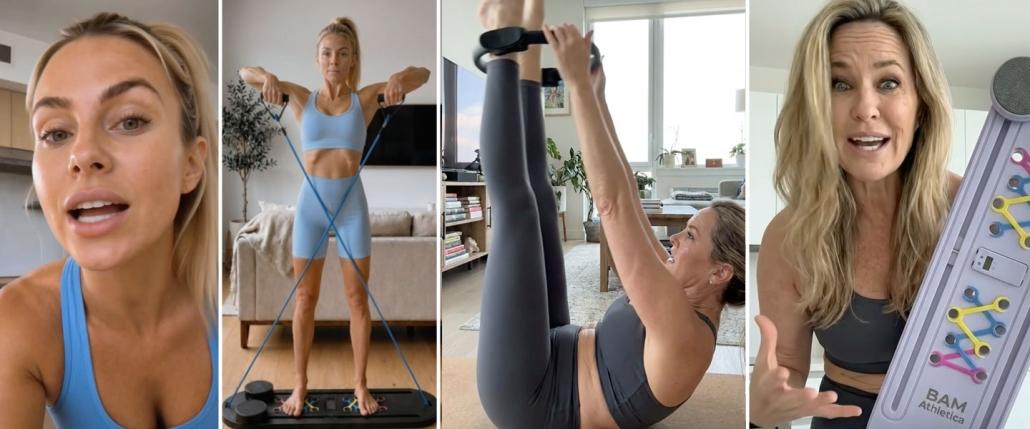
D2C launches are winning with generative AI and process automation to produce fast creative testing, targeted media buying, and attribution that connects social ads to eCommerce revenue.
Executive Snapshot
This case study shows how MJ Digital built a launch system for a D2C sports and athletics brand introducing an at-home Pilates reformer board for women.
MJ Digital led the strategy, creative operating model, paid media execution, and measurement framework, connecting generative AI video production, UGC-style social ads, automation, marketplace advertising, Google PPC, and eCommerce attribution into one coordinated growth engine.
The launch used two audience-led creative concepts to test distinct buyer motivations: a middle-aged mother looking to get back into shape and a younger Pilates/yoga lifestyle buyer seeking convenience, wellness, and at-home movement.
The result was a scalable creative and performance flywheel designed to move from AI-assisted ad creation to traffic generation, marketplace activity, eCommerce conversion, and sales learning.
- Client category: D2C sports and athletics brand
- Product: At-home Pilates reformer board for women
- Sales channels: Amazon, Walmart, and D2C eCommerce website
- Media channels: Facebook, Instagram, TikTok, Amazon Ads, Google PPC
- MJ Digital role: Executive strategy, campaign brief, campaign launch architecture and playbook, ad creative direction, generative AI advertisement development (UGC social video ads), media buy & management, measurement and attribution implementation and reporting, and team-led execution
KPIs
- Awareness & Demand: Impressions, reach, views, and attributed brand searches
- Creative Engagement: A/B testing on thumb-stop, watch time, shares, saves, reposts, favourites
- Demand & Traffic: Referral sources, Sessions, product-page visits, engaged visits, marketplace clicks
- eCommerce Performance: Add-to-cart, checkout starts, purchases, conversion rate
- Acquisition & Revenue: CAC, CPA, ACOS, ROAS, attributed sales, channel revenue
- AI Production Efficiency: Production speed, ad volume output, automation impact, time saved versus traditional Marketing Ops. production
Current State
A D2C sports and athletics brand was preparing to launch a new at-home Pilates reformer board for women across Amazon, Walmart, and its own eCommerce website.
The product sat in a strong market position: women wanted Pilates-style movement at home without studio prices, class schedules, commuting, or bulky equipment.
The launch needed to position the product clearly and honestly: a compact, foldable, reformer-inspired board for low-impact movement, toning, mobility, and at-home consistency. The playbook defined the product, as a studio-alternative, not a full commercial reformer replacement covering the campaign brief, target personas / IDP, brand positioning, product messaging, creative concept, etc.
The brand needed more than social ads. It needed a connected launch system from strategy to creative to media execution to revenue measurement. The vision was production of UGC social media videos produced and delivered through generative AI tools for creative, workflows, scripts, and full production to understand feasibility and quality to enable a constant flywheel of UGC videos through generative AI video and creative production and execution.
The Opportunity
The launch had three pressure points.
First, the UGC social videos needed fast production, fast creative learning and high quality outputs.
The idea was to understand if generative AI was at a level today where production and execution of UGC videos could be produced quickly with high quality output whereby a semi or fully automation process could establish a video content engine of UGC videos.
Paid social across Facebook, Instagram, and TikTok requires constant testing of audience targeting, hooks, avatars, engagement, product demos, CTAs, and objections.
Second, the media buy had to support multiple conversion paths. Amazon and Walmart were key marketplace channels. The D2C site was important for long-term brand value, customer ownership, and margin control. Google PPC was needed to capture high-intent search demand.
Third, the team needed attribution that could show more than engagement. The real question was: which ads drove qualified traffic, product-page visits, marketplace action, eCommerce conversions, and sales efficiency?
Concept / Solution
The launch introduced two AI-assisted video concepts built around distinct female buyer avatars.
Video 01: The Middle-Aged Mother Getting Back in Shape
This concept targeted a woman in her 40s who wants to feel stronger and more consistent, but does not want intense workouts, crowded gyms, or expensive studio commitments.
The emotional tension was privacy, confidence, time, and getting back into a routine.
The positioning: low-impact Pilates-style movement at home that feels realistic, private, and repeatable.
Hook direction: “I didn’t a bunch of Pilates gear that gives the illusion I’m in shape. I needed a solution that I could actually do, consistenly, at home on my schedule.”
Video 02: The Pilates + Yoga Lifestyle Buyer
This concept targeted a late-20s to early-30s wellness-minded woman already into Pilates, yoga, clean living, and aesthetic home fitness.
Her tension was the social image of a Pilates-girl, studio cost, schedule friction, small-space living, and wanting Pilates equipment that fits her lifestyle.
The positioning: a compact, reformer-inspired Pilates board that fits her routine, apartment, and wellness identity.
Hook direction: “I had the Pilates-girl math all wrong. I found a Swiss army-knife of Pilates equipment for at-home workouts.”
Solution: Generative AI Video Production Approach
MJ Digital led the AI video production and workflow as a structured creative system, not a one-off prompt experiment.
The process started with a campaign brief and playbook covering all the necessary information; including target audience and the various personas / avatars (goals, needs, pain points, etc.), audience avatar concepts, brand messaging, product positioning, buyer objections, hook strategy, and short-form ad scripts.
From there, the team used Nano Banana Pro for building and polishing the product visuals, hero images, thumbnails, backgrounds, and clean text overlays that could support UGC-style video ads. These assets helped keep the product presentation consistent, clear, and ready for social formats.
The video production layer used Veo 3.1 and Seedance 2.0 for different creative needs.
Veo 3.1 supported high-quality short-form video generation with the realistic motion necessary for realism and product usage, vertical social framing, and native audio, making it useful for creator-style scenes such as a fitness avatar introducing the product, delivering a hook, and closing with a lifestyle product shot.
Seedance 2.0 supported multimodal, reference-led video creation where text, image, video, or audio prompts guided camera movement and angles, lighting, creator style, scene direction, and product-demo pacing.
The workflow connected the tools into a repeatable production sequence: Nano Banana Pro for product and visual assets → Veo 3.1 and Seedance 2.0 for UGC-style video scenes → editing into short-form ads with a hook, product benefit, proof/demo moment, and CTA.
The automation layer was built around prompt templates, avatar inputs, script structures, asset naming, review checkpoints, channel adaptations, and performance readouts. Through this experiment, we identified new capabilities to improve on the workflow automation and process for future generative AI video needs.
Combined, this produced a Digital a scalable creative flywheel for UGC social ads: creative, scripting, voice over, development, edits, pre and post production. Combined enabled the production-ready UGC videos to launch into the Social platforms of Meta and TikTok, and feed the next ad sprint.
Development and execution
MJ Digital’s team developed the broader social ad system around speed, realism, and channel fit.
Each ad followed a social-first structure: pattern interrupt in the first two seconds, problem hook, product demo, benefit proof, and a clear CTA with brand repetition for Search recognition.
The product had to appear early, feel native to the channel, and answer one buyer objection at a time: space, cost, stability, beginner confidence, workout variety, or purchase trust.
The ads were adapted across Facebook and Instagram placements, including Feed, Reels, Stories, and video placements; TikTok for native short-form product discovery; Amazon Ads for shopper intent; and Google PPC for search demand capture.
Media management included audience testing, persona / avatar testing, budget allocation including ACOS and ROAS management, campaign setup, creative rotation, campaign QA, weekly optimization, and performance readouts.
Every asset passed human QA for product accuracy, AI realism, claim safety, usage rights, marketplace compliance, brand recall, and channel fit.
Measurement and attribution
Measurement was built into the launch from the start.
For Amazon.com marketplace measurement, tracking was performed through Amazon Attribution and Brand Analytics, connecting off-Amazon media activity to Amazon shopper behavior, including brand search lift, attributed product-page visits, add-to-cart activity, purchases, sales, and ROAS where available.
For D2C eCommerce measurement, tracking was performed through Google Analytics / GA4 eCommerce reporting, supported by UTM structure, campaign naming conventions, event tracking, and sales-channel reporting.
This allowed MJ Digital to evaluate how paid media influenced website sessions, product-page views, add-to-cart actions, checkout activity, conversion rate, revenue, and blended CAC.
Core KPIs included standard Social video ad KPIs (ex. hook effectivness, thumb-stop rate, 3-second view rate, hold rate, average watch time, CTR), and broader campaign KPI’s as CPC, CPM, landing page views, product-page visits, and eCommerce and broader Marketing effectiveness with add-to-cart rate, checkout starts, purchase conversion rate, CPA, CAC, ROAS, marketplace sales, D2C revenue, and blended contribution margin.
Results & Impact
The engagement created a scalable D2C launch engine that connected AI-assisted creative production, paid media execution, marketplace attribution, and eCommerce measurement.
Instead of treating the launch as a one-off campaign, MJ Digital built a repeatable system with automation for production, testing creative, measuring traffic and sales impact, and feeding performance learnings into the next social ad sprint.
- AI Creative Output: 2 hero video concepts developed across priority buyer personas.
- Creative Variation: Multiple hook variations and channel-specific ad formats produced.
- Production Speed: Product and creative cycle reduced from 3-4 weeks to 4 days (and improving with each new version)
- Media Reach: 5-day execution with extremely conservative daily budget netting 6-figure impressions generated across Meta, TikTok, Amazon, and Google.
- Awareness & Demand: Attributed brand searches increased by 245% over the campaign timeframe across Amazon.
- Traffic Efficiency: Paid social CTR reached ranged 2% to 5%, with CPC improvements (confidential)
- Amazon Attribution: 40% growth product-page visits, [confidential] lift in D2C add-to-cart, checkout and purchases across eCommerce website and marketplaces.
- Acquisition Efficiency: Blended CPA [confidential]
- Revenue Efficiency: ROAS reached [confidential] across tracked conversion channels
- AI Production Efficiency: Production time reduced by 90% versus historical production workflow
- Soft Victories: Operational and creative learnings, all captured and converted into the next sprint backlog.
The Takeaway
The core value of the engagement was not simply creating a generative AI solution for Social and Marketing ads. It was building a faster Marketing Ops. production system the client did not have in-house: strategy, AI-assisted creative workflow and production, experiment with UGC content, media execution, attribution to what matters most, and performance learning.
By combining generative AI with process automation, MJ Digital demonstrated modernized Marketing that helped close gaps in Marketing Ops and Comms. creative velocity, campaign production and testing, marketplace measurement, and performance reporting.
The new AI solution gave the Marketing team data-driven insight into which avatars held attention, which hooks drove viewership, which channels created qualified traffic, and which ads moved shoppers toward product-page visits, add-to-cart activity, and purchases.
The broader lesson is clear: the advantage of AI in marketing is not more content for its own sake. It is faster learning, supporting gaps in missing skillsets, sharper creative testing, the ability to evolve quickly before consumer channels become saturated and ad-blindness occures, and lastly to enable a new tool in Marketings toolbox to be adopted for future sales and marketing programs and campaigns.