
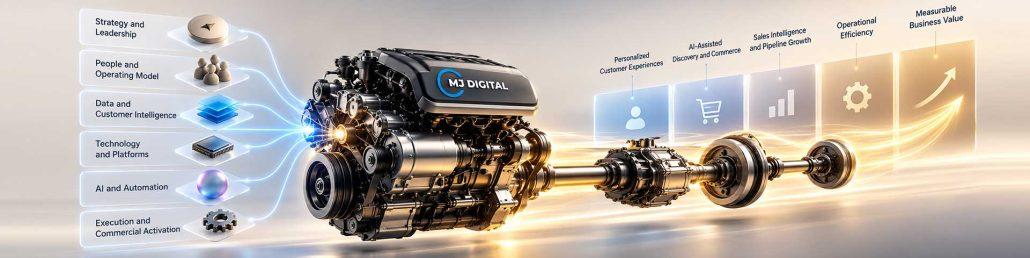
Building a connected digital growth engine is one thing. Making it deliver measurable business value is another. I've seen how fragmented ownership and systems, competing priorities and disconnected execution can slow even the strongest digital strategies. And as AI reshapes how customers search, discover, shop and buy, the challenge isn't just having the right technology — it's building an operating model that can turn intelligence into action, at scale.
The Growth Engine Series: Connect. Operate. Unlock.
Building a digital growth engine isn’t a one-and-done project. In this three-part series, I share my experience and perspective on how digital hungry businesses and enterprises connect digital capabilities and people to turn them into measurable commercial value, results and unlock new opportunities for growth.
- PART 1 — Connect: Building the Next Growth Engine: I explore how connecting Digital, Data, Technology and AI around customer needs creates stronger relationships, smarter experiences and new growth opportunities.
- PART 2 — Operate: Making the Growth Engine Work: Learn how leaders align strategy, people, technology and customer intelligence through a Digital and AI-ready operating model to improve execution and deliver measurable commercial results.
- PART 3 — Unlock: Beyond Optimization — Turning Digital Capabilities into Growth: I explore how businesses build on those capabilities to identify unmet customer needs, create new products, services and revenue opportunities, and scale profitable growth.
In the prior post, Part 1: Building the Next Growth Engine, I explored how connecting Digital, Product, Marketing, Data, Technology, CX and AI around the customer can create deeper relationships to unlock that commercial growth.
But building a connected ecosystem to enable a growth engine is one thing. Making it deliver the right experience with measurable business value is another.
I’ve seen how fragmented ownership, competing priorities and disconnected execution can slow even the strongest digital strategies. And as AI reshapes how customers search, discover, compare and buy, the challenge isn’t simply having the right technology. It’s building an operating model (and the right people) that turns customer intelligence into action, at scale.
So how have I made it work?
1. Invest in Customer Outcomes, Not Disconnected Projects
Marketing wants personalization.
Commerce wants conversion.
Technology needs scalable platforms.
Product has a roadmap.
Data teams have competing priorities.
Executives want profitable growth, stronger customer relationships, operational efficiency and measurable returns on investment.
They want to know whether the business is growing, becoming more competitive and using capital effectively.
In short, everyone is busy. But are they working toward the same outcome and rising the tide of all teams?
For example, in financial services, where digital-first competitors are challenging traditional customer relationships, this distinction matters.
DBS Bank’s “Managing through Journeys” approach offers a compelling example of organizing cross-functional capabilities around customer experiences, supported by data, AI and measurable business outcomes.
For leaders, the shift is practical: fund priority customer journeys, assign business and technology co-owners, and give teams shared goals and targets for adoption, growth and efficiency.
The question isn’t what technology should we build next, or what shiny AI capability are need yesterday, but what customer or commercial outcome should we improve next?
2. Give Business and Technology Shared Ownership
An operating model isn’t another organizational chart. It’s how investments are prioritized, decisions get made, teams execute and results are owned.
Just consider the global payments and money-transfer industry as a perfect storm example. Established financial institutions face growing disruption from digital-first fintechs, pressure to find new ways to reduce transaction costs and fees, and rising customer expectations for faster, cheaper and more seamless cross-border payments. At the same time, the global industry of traditional intermediaries are being challenged and reshaping how money ad the transaction is can move with the acceptance and growth of blockchain-based payment networks, stablecoins and decentralized finance (DeFi).
In that environment, I helped connect Search, Marketing, Digital Product and Platforms, Data and Analytics and Salesforce-powered capabilities across more than 70 regional websites where digital experiences becoming front-and-centre vs simply an online doorway for customers to deposit and move money.
Creating shared capabilities across teams, keeping the customer experience as your north start, all while preserving local execution contributed to a broader growth program that worked. Incremetnal revenue grew 8-figures and fivefold eCommerce growth.
The lesson?
Shared technology, data and platforms only create value when teams are aligned and collaborate around a clear North Star, common priorities, decision rights, accountable ownership and measurable business outcomes.
It’s not much different than a sports team and their players functioning in different roles while executing together cohesively to run a play and adjusting in real-time to achieve their common shared goal to score.
It sounds simple. But as organizations grow, new leaders, departments and layers of decision-making often bring competing priorities.
Silos deepen, accountability becomes fragmented, mediocracy breeds mediocracy, and execution slows.
It’s one reason digital transformation in large enterprises can feel like trying to move a mountain.
I’ve seen how dedicated cross-functional teams, internal innovation incubators and accelerators can help break through these barriers. But speed and innovation alone aren’t enough.
These teams need the autonomy to experiment, the room to connect and collaborate, the support to scale successful ideas, and a clear connection to enterprise strategy, shared technology foundations and commercial goals.
The real transformation happens when innovation isn’t isolated from the business, but becomes part of how the business operates and grows.
Rather than handing projects between departments, leaders need cross-functional teams that continuously improve priority customer journeys, supported by reusable technology and data services.
3. Build AI-Ready Data That Connects Discovery to Commerce
Automotive retail is a good example to show why this matters as its a B2C model that’s still evolving into a D2C retail opportunity.
Vehicle affordability pressures and increasingly digital shopping behaviour are pushing dealer retailers to improve qualified demand, conversion and customer experience.
Cox Automotive’s 2025 Car Buyer Journey Study confirms that buyers increasingly expect connected online and in-person experiences.
Meanwhile, Hyundai and Amazon Autos are linking digital shopping activity to dealership sales.
Hyundai’s published case study demonstrates how online discovery signals can support Marketing and advertising activation and measurement of offline purchases.
I saw a similar opportunity within a national automotive retail group with almost 40 retail dealerships and an online marketplace.
Anonomyous shoppers and known customers were revealing shopping behaviors, vehicle and financing preferences and purchase intent through searches, browsing and discovery, inventory views, calculator interactions and their digital behaviour.
But the problem was those behaviors, preferences and signals weren’t captured and connected to identities and profiles, let along connected to sales activity and commercial outcomes. Only once the anonomyous shopper engaged the business, a minimal set of basic contact information was collected.
I led a team to develop a digital experience approach that captured digital shopping behaviour, identified buying signals and connected anonymous visitors to known leads, prospects and customers.
By combining marketing automation and CDP capabilities, we could turn those behaviors and high-value signals into actionable customer intelligence — enabling personalized experiences, predictive propensity models to identify purchase intent and recommend next-best actions.
These insights also helped Business Development and retail sales teams better understand customer needs, prioritize opportunities and have more relevant, personalized conversations, supported by AI-driven sales intelligence.
The objective was to help Marketing and Sales recognize intent earlier, tailor engagement and guide customers toward a more relevant purchase experience.
Now consider the next evolution.
Customers increasingly use AI to research products, compare options and receive recommendations. [Walmart’s AI-first shopping initiatives] demonstrate the direction of travel toward conversational discovery and agentic commerce.
To compete, businesses need accurate product content, pricing, inventory and customer information accessible through governed systems.
CRM, PIM, ERP, CDP and commerce platforms must work together, even when vendor integrations and data access are limited.
The goal isn’t to centralize everything. It’s to enable capabilities to work together for a connected orchestration and experience, and make trusted intelligence available wherever people or AI agents make decisions.
4. Turn Customer Intelligence Into Commercial Action
Connected data only creates value when it changes what a business does next.
Whether in retail eCommerce or B2B, the opportunity is to turn future and existing customer signals into smarter decisions, more relevant experiences and measurable growth.
Retail eCommerce: From Product Discovery to Personalized Shopping
In retail, customers move between search and discovery channels; Google, social media, ads, onsite search, product recommendations and increasingly AI assistants to ask questions, research, compare and even buy.
Amazon illustrates this shift through its AI shopping assistant, Alexa for Shopping (formerly Rufus), which uses product information, shoppers search terms and queries, and behavioral shopping context to help customers discover products, compare options and receive personalized recommendations.
For retailers, connecting product data, inventory, customer preferences and shopping behaviour creates opportunities to personalize content, recommend next-best products and improve conversion. AI can make these experiences more conversational, relevant and responsive to customer intent.
I hold no crystal ball, but I foresee this as the first step in a major shift how people search, discovery, buy and engage. Thinking about all of todays connected devices, from Alexa to a digital billboard on Robson Street to my connected runners, AI and agentic only needs to be introduced to tailor and even automate experiences from a conversation with the connected device (think ‘Hey Siri’ x 10).
B2B: From Customer Intelligence to Revenue Opportunities
In B2B markets, ex. the Heavy Equipment market, purchasing decisions often involve multiple stakeholders, longer sales cycles and ongoing needs for equipment, parts, service maintenance and operational efficiency.
At one of Caterpillar’s largest heavy-equipment dealers, the disconnected customer, equipment and commercial data made it difficult to identify opportunities across the customer lifecycle for Sales and Marketing activation, let alone AI prior to their digital transformation mandates.
In this example, once area I led was the Marketing data, analytics and MarTech CDP strategy to create a unified customer identity across a global fragmented ecosystem of tools and tech where customer data lived. I had to find a way to access, cleanse, structure and the connect customer, digital and operational signals (1st and 3rd party data) with targeted Marketing and Sales use-cases.
Once the POC was validated, the team shifted into the the MVP for first 2 use cases, where the first generated over $10 million in digital self-serve incremental revenue and $50 million in pipeline opportunities, and the second dramatically improved the ecommerce account acquisition and onboarding experience, while maximizing 100% of global customer coverage across NAmerica, SAmerica and Europe.
AI offered the next opportunity: identifying website, ecommerce and SaaS buying signals, recommendation engine for relevant content and products, preparing personalized sales conversations and helping Business Development teams prioritize accounts and Sales teams to move opportunities through the pipeline.
The Operating Model Connects Both
Marketing, Sales, Merchandising, Product, CX, Data and Technology need shared priorities, accountable owners and a continuous process for turning insights into actions, testing results and improving performance.
The data enables the foundation. Activation creates intelligence. Execution and its orchestration creates commercial value.
5. Measure Value, Not Project Completion
A successful technology launch isn’t necessarily a successful investment.
Every major initiative needs a business owner, a baseline, measurable commercial targets and a clear decision to scale, improve or stop.
Track adoption, engagement, conversion, qualified pipeline, incremental revenue, margin, retention, productivity and cost to serve.
For AI, add accuracy, recommendations, privacy, security, customer trust and human oversight.
Start with a high-value customer journey. Establish the baseline, connect the required capabilities, test improvements and measure what actually changes.
Then reinvest in what works.
This is how digital transformation becomes a continuous business capability rather than another technology program.
The Next Growth Engine Is a Leadership Decision
AI will continue changing customer expectations, business processes and how commerce works.
But competitive advantage won’t simply belong to organizations with the most tools or the largest budgets.
It will belong to those that connect strategy, trusted data, technology, people and execution that connects with customers — turning your data and customer intelligence into better ‘personalized’ experiences, faster decisions and measurable growth.
The next growth engine isn’t something you buy. It’s something you organize your business to deliver.