
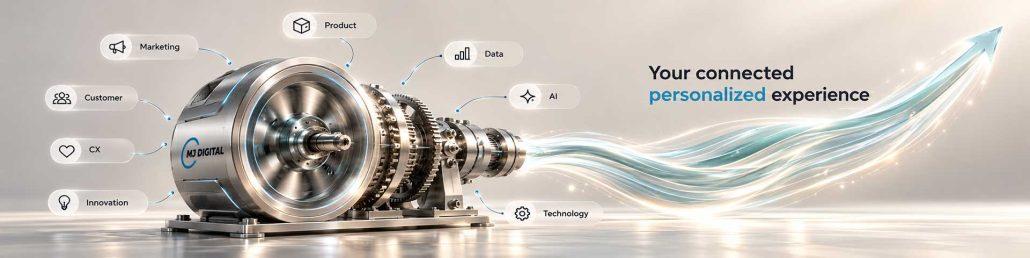
Building the Next Growth Engine: Turning Digital, Data and AI Into Deeper Customer Relationships
Adobe Marketing CloudArtificial Intelligence (AI)CDP & Customer 360Customer Experience (CX)Data & AnalyticsDigital TransformationEcommerceMarTechOperational ExcellenceSalesforce Marketing Cloud Account Engagement | B2B

Part 1: Building the Next Growth Engine – Turning Digital, Data and AI Into Deeper Customer Relationships

The next stage of digital transformation is not adding more technology. It is connecting Product, Marketing, Sales or eCommerce, 1st and 3rd party Data, AI Technology and automation into one customer growth system.

The Growth Engine Series: Connect. Operate. Unlock.

Building a digital growth engine isn’t a one-and-done project. In this three-part series, I share my experience and perspective on how digital hungry businesses and enterprises connect digital capabilities and people to turn them into measurable commercial value, results and unlock new opportunities for growth.

  • PART 1 — Connect: Building the Next Growth Engine: Keep reading below. Read below where I explore how connecting Digital, Data, Technology and AI around customer needs creates stronger relationships, smarter experiences and new growth opportunities.
  • PART 2 — Operate: Making the Growth Engine Work: Learn how leaders align strategy, people, technology and customer intelligence through a Digital and AI-ready operating model to improve execution and deliver measurable commercial results.
  • PART 3 — Unlock: Beyond Optimization — Turning Digital Capabilities into Growth: I explore how businesses build on those capabilities to identify unmet customer needs, create new products, services and revenue opportunities, and scale profitable growth.

Most companies have already invested heavily in digital. 

They have websites, apps, CRM, MarTech, eCommerce, PIMs, data clouds, analytics, automation, customer data platforms and now AI.

The problem is that many of these capabilities were set up or built separately, funded separately and managed by different teams with different goals and priorities.

Individually, they may work well.

Collectively, they often do not work together well enough to create their full customer and commercial value.

So is it a Digital or technology issue, or a human foresight, planning or change management issue?

I’ve seen this firsthand: companies can end up chasing their own tail — copying what a competitor is doing or buying into the big vision and story a technology vendor has sold them.

The problem is the narrow lens. The influence behind the decision is often driven by an immediate need, one team or one capability, or even served some great koolaid from a technology sales rep. with a great story behind the art of whats possile, all without stepping back to ask how it connects to the broader priorities of the customer and the business.

The bigger opportunity is to look across the business and its ecosystem: how can this investment solve today’s problem while also creating reusable data, capabilities and connections that help other teams, unlock future use cases and make the business faster and more adaptable?

That is the difference between buying another solution and building a growth system.

It creates duplicated and even triplicated investment, fragmented experiences with guests/leads/customers, slower execution, technical debt, limited adoption, weaker personalization and lower returns from technology that was supposed to make the business faster and smarter.

The problem is often not that companies need more digital capability. It is that the capabilities they already have are disconnected.

Customers do not experience your org chart

Marketing has a strategy.

Product has a roadmap.

Technology has priorities.

Data has a backlog.

CX has journey maps.

AI has pilots.

Each team may be doing good work, but they may not be solving the same customer or business problem.

Customers experience something very different.

They move through one connected journey, and not in a perfect fluid way:

Need → discovery → consideration → conversion → post-purchase experience or onboarding  → repeat

They do not care which internal team owns each step.

Customers do not experience your org chart. They experience the gaps between it.

The bigger opportunity is to stop optimizing isolated capabilities and start connecting them around customer needs and measurable business outcomes.

Data is not just infrastructure. It is strategic IP and is now an asset.

Data earns the label “asset” in my books because, when a company can control, organize and activate it, it has the potential to create future commercial or economic value.

Used well, customer data can improve personalization, targeting, product decisions, sales prioritization, automation, customer experience, AI capabilities, influence why a customer chooses to do business with you and unlock new products or revenue opportunities.

Its value can also compound as the business learns more about its customers, connects more signals and creates more ways to act on that intelligence.

And now with the rapid pace of where AI and agentic is going, your data will become the fuel to power solutions that drive new and incremental growth – so why now view it as asset? 

The opportunity is to move beyond:

Data → reporting

toward:

Data → intelligence → decision → action → customer outcome → commercial value → repeat

That is where data becomes strategic IP.

Conversely, when data is not kept clean, structured, accessible and usable, it becomes data debt — increasing maintenance cost, slowing decisions, lack of business adoption and delaying new customer, AI and growth use cases.

The longer data sits fragmented, siloed, unused or unconnected, the more value and opportunity the business loses.

This is also why I believe more organizations benefit from a strong Chief Digital Officer, or equivalent leader, who can bridge the commercial side of the business — Sales, Marketing and customer growth — with Technology, Data and Operations.

I think of that role as both translator and conductor is to an orchestra — aligning teams, priorities and capabilities from the top down so the different parts of the business can move in sync around shared customer and business outcomes.

Done well, that leader can also challenge the habits, silos and that “it’s good enough” type of thinking that quietly breeds mediocrity to unblock growth and innovation.

Sometimes unlocking growth starts with removing the internal friction that keeps better ideas from moving; whether its people, process or tech.

That alignment becomes even more important with AI.

If customer data is fragmented, inaccessible, poorly structured or unreliable, AI does not magically fix the problem.

It inherits it.

I learned this firsthand

I saw this while helping build and scale digital teams and capabilities with a local enterprise in a global market.

Like many organizations and brands, early digital priorities were heavily shaped by the voice of the business — two individuals who cast the largest shadow in the room, and what internal teams closest to the platform believed customers needed (without evidence or asking the customer or looking at the data) and what they prioritized engineering teams to build.

Monthly meetings turned into ideation and brainstorm sessions what to build next, vs. a focus on what existing customers are saying and what commercial business goals could align with the customer need.

That created a ceiling — and a major “ah-ha” moment — particularly once regional leadership had customer CSAT and digital index scorecards tied directly to annual performance and STIPs.

It didn’t take long for friction with customer adoption to become one of the loudest topics in the boardroom. 

I challenged the status quo to refram the conversation through a different lens: if we all left the company tomorrow, invested our own savings, built a startup together and launched the product to market, what would we treat as essential to its success?

That shifted the lens and discussion. Instead of focusing on blame or defending existing ways of working, the team began to see things differently, puttingand looking through the lens of the customer, and how customer input was one of the most important inputs to building a successful product and business.

Jeff Bezo’s of Amazon new this very early on, so much so he would ensure every meeting had one empty chair at the boardroom table; a visual reminder for any conversation that the customer was sitting at the table and a participant of that conversation.

That alternative lens helped shift the leadership teams thinking toward the importance of connecting three perspectives:

Voice of Business + Voice of Customer + Voice of Data.

Long story short, I led the CX initiative for this new SaaS customer portal to connect the 3 and how it fed into leaderships customer insights and woven into the fabric of the engineering product-development lifecycle along with receiving semi real-time feedback to the engineers to optimize and improve what they built. For business and product leadership it become the bedrock on what was truly important to prioritize.

Customer behaviour helped expose real needs and friction.

Data helped surface where friction and opportunity existed.

Business strategy provided the commercial context.

Together, they created better product priorities, shared roadmaps and clearer outcomes.

Ah, and the result? 45% lift in customer adoption, a shift in how engineering approached almost any other development project, and and internal change management example other teams adopted. 

One lesson stayed with me:

Building what the organization asks for is not always the same as building what creates the most customer and commercial value. 

The same lesson applies to Customer Search & Discovery

I’ve seen the same pattern across global websites, eCommerce, marketplaces and even intranets.

Search is often one of the earliest touchpoints in the customer journey, where people discover brands, explore options and signal intent.

Historically, businesses have treated Search as separate capabilities: Google and SEO to improve visibility, onsite search to help customers find products or information when poor UX, navigation and merchandising fail to influence what gets surfaced and when.

The bigger opportunity is to connect customer intent + signals  + user behaviour + product or knowledge data + content + personalization into one discovery system.

That matters because discovery is expanding beyond traditional search engines. Customers are increasingly finding brands through AI assistants, conversational tools, personalized search experiences and emerging AI agents.

Search is no longer just a traffic channel. It is becoming a #1 behavior to seek an answer or solution, a source of customer intelligence and a way to improve relevance, conversion and discoverability wherever the customer is asking a question.

And that matters because AI is about to change discovery even further.

AI is about to make connection even more important

Today, many organizations still think about AI primarily as a chatbot, Copilot or productivity assistant.

That is already changing.

Agentic AI is moving toward systems that can understand intent, coordinate tools, compare options, make recommendations and complete tasks within defined permissions.

That changes how customers “discover” and interact with brands.

Historically:

Search → browse → click → website → compare → leave or buy.

Increasingly:

Ask → AI tool, assistant or agent → recommendation → action or influence (build confidence or trust).

Near-term future:

Search → brand/product discovered + participate in the AI conversion → website → identify user and pull relevant data→ personalize experience → track + profile shopper progressively → watch for signals → continue to personalize → Influence path-to-desired-outcome (customer or commercial outcome) → conversion → repeat

That conversation might happen through a GPT conversation, Siri, Website + search experience, wearable tech, smart vehicle, smart-home device, shopping assistant, Google AI answer or another connected device or touchpoint with an AI conversational experience.

But the achilles heel is that if your data-house is not in order, good luck. AI won’t magically work in the way you need if your data is not in order, let alone connected.

So the strategic question becomes:

Is your business structured so intelligent systems like an agentic AI solution or agentic commerce can understand, interpet, trust, recommend and eventually transact with your brand?

The next battle for discovery may not simply be ranking first on Google. Traditional SEO is still vitally important because today’s AI discovery often builds on the same underlying content and authority signals.

But it may be whether your brand becomes part of the trusted answer or source inside someone else’s personal AI conversation.

And that future will depend heavily on the foundations companies build now: structured data, trusted content, connected platforms, accessible product information and reusable capabilities.

If those pieces remain fragmented today, businesses may will struggle to participate intelligently in tomorrow’s customer journey and conversations.

Insight

A big part of unlocking data’s value is connecting data and customer signals across systems.

How? In simpler environments, a marketing automation tool can bookstrap connecting identifies, and a morre mature CDP or hybrid data lake approach to unify user/customer/guest identities, build profiles and activate audiences. In more complex ones, it may not be able to ingest, model or resolve every source the business needs.

For example, if you had website behavioral data, marketing campaign and performance data, CRM data, PIM data, eCommerce inventory and pricing data, ERP data, financial data, telematics data, etc. will a CDP investment cover all situations, and without heavy re-engineering? Is it flexible and agnostic enough to future-proof your data connectivity needs?

That is where a hybrid approach helps.

Data can first flow into a shared lake, warehouse or cloud foundation.

Cleanse it. Structure it. Prepare it.

But at the identity layer you can combine both deterministic matching — such as customer ID, email or phone — with probabilistic using an AI-assisted matching model to connect incomplete, anonymous or harder-to-resolve records. A similar approach with AI assisting can also be performed even before this step with deduping records.

The unified customer profile can then span both the CDP and a proprietary identity layer, using each where it is strongest.

This is important to understand as this is the heart of where the ‘connected’ experience starts. 

The goal is not one perfect platform. It is a trusted, connected customer view that can power Marketing, Sales, Product, Service, personalization, analytics and AI.
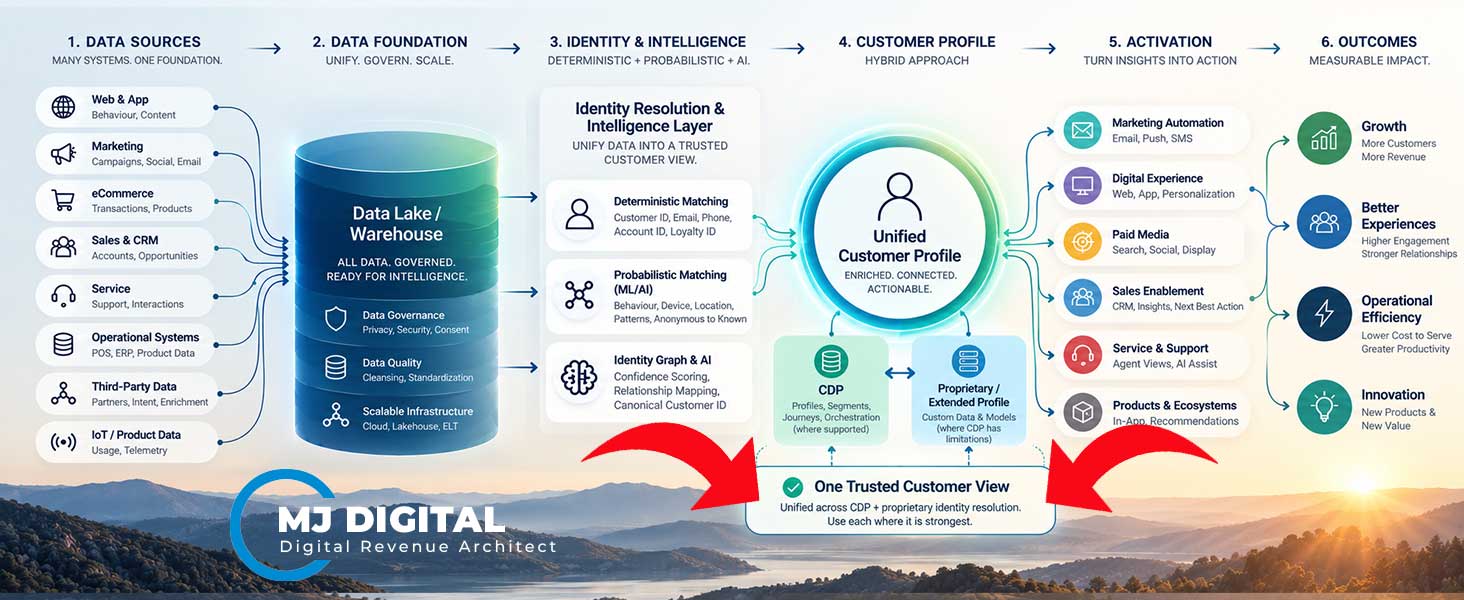
Hybrid customer data architecture showing multiple source systems feeding a governed data lake, then using deterministic, probabilistic and AI-assisted identity resolution to create one trusted customer profile across a CDP and proprietary identity layer, which activates personalized experiences across Marketing, Sales, Service, Digital and Product to drive growth, better experiences and operational efficiency.

That is what makes data connective tissue across the business.

Many different systems combined or siloed store data and create signals, but the value comes from stitching or unifying them and making that intelligence usable wherever the next customer interaction happens; on your website and Search, in an AI agent or tool, or even an eCommerce product feed that AI tools as GPT, Claude and Copilot that makes it easier to understand your structured product data or unified data to help it surface your brand or product in its answer and index source for the next personalized search your customers perform in their tool of preference.

Build a connected growth system

I believe leaders should look at digital growth through five connected layers:

Customer — What problem or goal are we helping solve?

Growth — How do we acquire, convert, expand and retain?

Experience — How should digital and human journeys work together?

Intelligence — How can data and AI improve decisions and actions?

Platform — What technology and capabilities allow us to scale?

Across all five sit the foundations that make the system work:

Operating model + adoption + governance + measurement.

Before making the next major digital or AI investment, I would ask:

  • Are our Product, Marketing, Data, Digital and Technology strategies actually connected?
  • Are we using customer data mainly to explain what happened, or to influence what happens next?
  • Are our AI investments tied to clear customer or commercial use cases?
  • Can we explain how our digital investments improve growth, customer value, operating performance or speed?

What’s next: Making the Growth Engine Work

The next stage of digital transformation is not digitizing more of the business. It is building a business that knows how to operate to enable digital growth.

Connecting Digital, Data, Technology and People is the foundation. But how do you turn those capabilities into measurable business results?

In my follow-up article, Making the Growth Engine Work – Build a Digital and AI-ready operating model, I explore how shared leadership, Digital capabilities, an AI-ready operating model and coordinated execution turn data and customer intelligence into commercial value.

This is the work I focus on: helping leaders connect Digital, Product, Marketing, Data, Technology, Automation and AI into growth systems that create measurable customer and business impact. 

Go questions, needs or just need a sounding board for your ideas or challenges you’re facing? Reach out for a conversation.