

Enterprise MarTech fails when platform selection starts with features instead of fit. For global teams, the right platform must support the business model, sales process, data architecture, regional workflows, governance, and end-user adoption.
This case study shows how a global heavy equipment enterprise evaluated marketing automation as a long-term revenue growth platform, not just another software purchase
Executive Snapshot
A global heavy equipment enterprise operating across mining, oil, construction, and industrial markets needed to evaluate which enterprise marketing automation platform was the best fit for its global business and regional nuances.
As one of the largest global Caterpillar dealers, the organization had multiple regions across South America, North America and Europe, numerous business units across industry teams, sales teams, marketing teams, CRM environments, customer data sources, and regional campaign needs.
The goal was not to choose the MarTech platform with the longest feature list.
The goal was to identify the right business fit: a marketing automation platform that could support global and local needs and scale, regional localization, CRM integration, data activation, ABM (account based marketing), lifecycle marketing and pipeline sales lead nurturing, governance, adoption, and a 3-year capital investment business case.
The initiative was led by MJ with a core team of 3 and a support group of 5.
Proof Snapshot
- 20+ global stakeholders engaged Workshops across 3 regions, 6 countries and 4 locations.
- 140+ user stories captured across multiple business units and teams.
- 8 business-fit MarTech evaluation criteria developed.
- Enterprise marketing automation platforms evaluated; Oracle Eloqua, Adobe Marketo Engage and SalesForce Marketing Cloud Account Engagement.
- Business case created to support the capital investment over 3-year TCO horizon.
- Future-state roadmap developed for CRM, data, website, reporting, personalization, and CDP readiness
The Business Challenge
The organization had made digital transformation a global strategic priority.
Leadership knew the pace of change could not be driven by the traditional business alone. To accelerate progress, the organization created a separate digital group designed to act as both an accelerator and incubator for the broader enterprise.
This group brought together specialized talent across data science, digital marketing, website and product management, change management, communications, and finance. It was built to operate “on the edge”: connected enough to the global business to stay aligned with enterprise priorities, but independent enough to move with startup speed and foster new ways of thinking, new approaches and spark innovation.
The mandate was clear: bring more agility, experimentation, creativity, focus, flexibility, accountability, and innovation into how the organization approached digital growth.
MJ was brought in to help establish and lead key areas of the digital group, with a focus on digital marketing including marketing automation, website strategy and development, UX design, and marketing data and analytics.
One of the first major global priorities was marketing automation.
The organization recognized that marketing automation was no longer a “nice to have.” It was becoming a core growth capability. But the business environment was complex.
Lead management varied by region. Campaign execution was highly manual. Data was fragmented across markets and systems. CRM structures were not consistent. Marketing and sales handoff processes needed more clarity. Regional teams needed flexibility, while the global business needed stronger standards, governance, measurement, and control.
The risk was not simply choosing the wrong software.
The bigger risk was investing in a powerful enterprise platform that teams would not fully adopt to unlock its value.
Without the right strategy, operating model, data foundation, and change-management plan, the platform could become expensive 6-figure enterprise shelfware — a Ferrari sitting in the garage instead of a growth engine on the road to win the race.
The Opportunity
The opportunity was to turn marketing automation into a scalable revenue system, shift Marketing from a cost-centre to a hybrid revenue-centre, and lead a first global operating model that can deliver lean and agile execution while ‘rising the tide’ of all global teams goals and priorities.
The right marketing automation platform could help the business:
- Improve lead capture and qualification
- Standardize marketing-to-sales handoff
- Support account-based marketing (ABM)
- Enable Sales intelligence by converting anonomyous website visitors to known leads and customers.
- Automate personalized lifecycle marketing including CRM funnel lead qualification and nurturing
- Identify high-intent buying signals
- Improve customer and account profiling (KYC – Know Your Customer)
- Connect marketing activity to CRM funnel impact
- Support regional campaign localization and execution
- Strengthen attribution and reporting
- Build a foundation for future CDP and personalization capabilities.
- Establish a Martech solution to support both B2B sales funnel model, a B2B/B2C eCommerce model and a SaaS customer portal model.
The work also supported a broader 3-year business case for capital investment. That business case looked at how marketing automation could improve the traditional B2B CRM sales funnel, eCommerce sales, SaaS customer portal lifecycle engagement, support CRM lead scoring and lead nurturing, and help sales teams identify better opportunities faster.
The Strategy Approach
The evaluation followed a structured business-fit framework.
Instead of starting with vendor demos, the team started with the business.
Phase 1: Business Alignment
The first phase focused on understanding the organization’s goals, growth priorities, regional differences, sales process, marketing maturity, data challenges, and future-state vision.
The key question was simple: What does this marketing automation platform need to help the business do?
Phase 2: Global Discovery Workshops
Workshops were hosted across 3 regions, 6 countries in 4 locations with cross-functional teams.
Participants included business unit leaders (new/used/rental equipment, aftermarket and services), marketing, sales, CRM, data and analytics, IT, data engineering, eCommerce, product, and regional operations.
The goal was to capture the real voice of the business: what teams needed, how did the desire and need engage their accounts and customers, where they were blocked, what was manual, what was inconsistent, and what they wanted the future platform to enable.
Phase 3: User-Story Capture
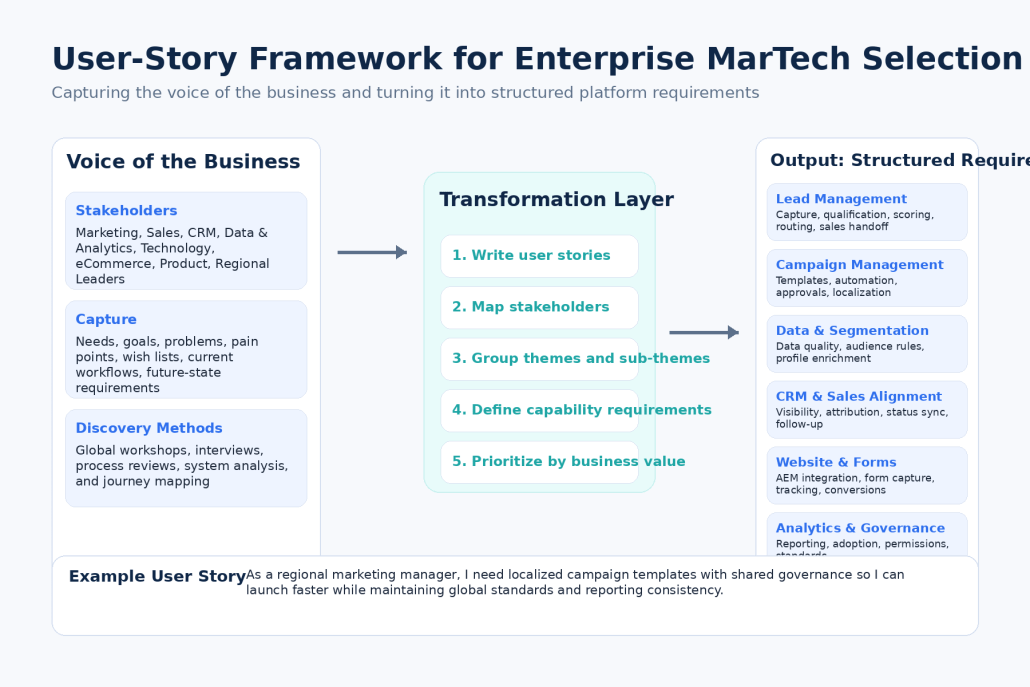
More than 140 user stories were captured from the workshops and interviews.
These user stories documented stakeholder needs, goals, problems, pain points, wish lists, and future-state requirements.
They were then mapped into business themes, sub-themes, stakeholder groups, and platform requirements.
This gave the evaluation a practical foundation. The platforms were not scored against generic features. They were scored against what the business actually needed.
Discovery: Key Themes
The discovery process surfaced several major themes through the workshops and user story creation.
Lead Management
Lead qualification, scoring, routing, follow-up, and marketing-to-sales handoff needed more consistency across regions and a Martech that would ‘play friendly’ with 5 difference CRMs; SalesForce, Microsoft, 2 custom and 1 OEM CRM tool.
Campaign Management
Campaigns were simple emails and execution was highly manual. Teams (creative, marketing, content) needed reusable templates with drag-n-drop content block flexibility, automation, localization workflows, custom lead routing, and better ways to scale campaigns across regions.
Data and Segmentation
Marketing teams needed cleaner data, stronger segmentation, better contact hygiene, and more reliable customer and account records.
CRM and Sales Alignment
The business needed stronger integration between marketing automation, the data lake (Azure), CRMs, sales activity, lead status, pipeline movement, and reporting.
Website and Form Integration
The future platform needed to integrate with the organization’s new Adobe Experience Manager website and web form strategy; another case study to be shared, a SDK-based solution, and digital conversion points.
Analytics and Attribution
Regional teams needed a clearer view of campaign performance, customer activity, sales lead movement, sales outcomes, and marketing contribution.
Governance and Adoption
The business needed common standards, training, user rights, platform governance, and a clear global-to-regional operating model.
Enterprise Scalability
The chosen platform needed to support multiple regions, large data volumes, APIs, custom data structures, sandbox environments, integrations, and future growth.
The Platform Evaluation Model
Each marketing automation platform was evaluated against 8 business-fit criteria themes.
These criteria were built from stakeholder discovery, user stories, and future-state needs.
1. Campaign Development
Could the platform support simple and complex campaign flows, forms, landing pages, dynamic content, segmentation, and personalized calls to action?
2. Campaign Operations
Could the platform support lead scoring, lead management, campaign reporting, attribution, and handoff into sales processes?
3. Data Integration
Could the platform connect with CRM, website, cloud data infrastructure, third-party systems, and future enterprise data architecture?
4. Data Management
Could the platform support subscription management, compliance, data cleansing, segmentation, analytics, and marketable-contact management?
5. Sales Operations
Could the platform help sales teams understand customer engagement, track communication signals, and act on higher-intent leads?
6. Platform User Experience
Would the platform be usable for global and regional teams? Could users build, edit, learn, and manage campaigns without unnecessary friction?
7. Customer Experience
Could the platform support more relevant customer engagement, onboarding, cross-sell, upsell, service communications, and personalized journeys across a B2B lead generation model, eCommerce model and SaaS PLD (product-led growth) customer portal?
8. Cost of Ownership
What would it cost to license, implement, operate, support, govern, and scale the platform over time?

Platforms Evaluated
The platform evaluation focused on enterprise MarTech solutions capable of supporting a global, multi-motion revenue operating model.
This mattered because the organization did not operate through one simple customer journey. It had a traditional B2B sales funnel, an eCommerce growth model, and a SaaS/PLG-style customer portal environment where digital behavior, product engagement, and self-service activity could signal customer intent.
The user stories captured during discovery surfaced a clear need for a platform that could do more than automate email campaigns. The business needed a system that could support lead scoring, lead nurturing, account-based marketing, CRM integration, website tracking, customer profiling, sales handoff, campaign localization, consent management, reporting, and future data activation.
The evaluation included the following enterprise options.

Adobe Marketo Engage
Adobe was included because the organization already had a digital experience foundation connected to Adobe Experience Cloud; Adobe Experience Manager (AEM), Adobe Analytics (website analytics), Adobe Target (personalization + experimentation) and Adobe Launch (platform tags).
This made Adobe a natural platform to evaluate for website integration, personalization, campaign orchestration, and future Adobe Target alignment.
The evaluation looked at whether Adobe marketing automation platform, acquired from Marketo, could support the organization’s broader digital experience goals across web, content, customer journeys, and regional campaign localization. It was especially relevant for a business that needed to connect marketing automation with website behavior, forms, digital engagement, and future personalization use cases.
Oracle Eloqua
Oracle Eloqua was included because of its enterprise marketing automation strength, scalability, lead management capabilities, campaign orchestration, custom data objects, and integration flexibility.
The organization needed a platform that could support complex B2B journeys, large data volumes, multi-region governance, lead scoring, nurture programs, and advanced segmentation. Eloqua was evaluated for its ability to operate as a scalable enterprise MAP that could support both global standards and regional execution needs.

SalesForce Marketing Cloud Engagement
SalesForce Marketing Cloud Engagement (formerly Pardot) was included because CRM integration and sales alignment were central to the business case. The organization needed marketing automation to support a traditional B2B sales funnel, where lead scoring, lead routing, opportunity visibility, and marketing-to-sales handoff were critical.
The evaluation considered whether SalesForce could help connect campaign activity, lead engagement, customer records, sales communications, and pipeline movement. It was especially relevant for improving sales visibility and supporting a more accountable revenue operating model.

Hybrid OEM Licensing Approach
The hybrid OEM licensing approach was included because the organization had access to a potential enterprise licensing path through its broader heavy equipment ecosystem.
This option was evaluated for its ability to reduce total cost of ownership while still providing access to enterprise-grade marketing automation capabilities, support, and best practices.
The evaluation also considered the trade-offs, including legal requirements, administrative duties, governance complexity, autonomy, and long-term flexibility.
Each option was assessed against the organization’s business goals, operating model, regional needs, data architecture, and 8 business-fit criteria among platform agnostic and flexibility was critical as the organization did not desire to license yet another technology simply as an off-shoot of an existing licensed tool due to cost effectivess. Business-fit was integral due to the complexity, scale, and decentralized structure of the global organization.
The goal was not to select the most recognizable technology brand.
The goal was to identify the platform that could best fit the business: a global enterprise with complex sales cycles, fragmented customer data, multiple regions, localized campaign needs, digital self-service journeys, and a growing requirement to connect marketing activity to measurable revenue impact.
Business Impact Model
A key part of the work was the 3-year business case.
The business case helped connect the platform decision to measurable commercial impact across the B2B sales funnel, while flexible to accommodate an separate eCommerce model and future SaaS PLD customer CX portal.
The model considered how marketing automation could support lead scoring, lead nurturing, ABM, KYC-style customer profiling, high-intent sales signals, and CRM funnel performance.
For eCommerce and the SaaS portal model, the MarTech has to consider lifecycle marketing with a focus on acquisition, account onboarding, and lifecycle marketing through to retention and churn goals.
Lead Scoring
The platform needed to help identify which leads and accounts were most likely to be ready for sales follow-up.
Scoring inputs could include profile fit, product interest, campaign engagement, website behavior, content activity, account value, quote activity, and sales communication signals.
Lead Nurturing
The business needed automated journeys that could educate, engage, and move prospects forward over time.
This included personalized nurture streams by region, product interest, account segment, industry, buying stage, and customer profile.
ABM Personalization
The marketing automation platform needed to support a more personalized account-based marketing (ABM) approach.
That meant helping the business understand target accounts, identify active buying signals, map customer needs, and support better sales conversations.
KYC and Account Profiling
The future-state model included richer customer and account profiles.
The goal was to connect digital behavior, CRM data, campaign activity, quote activity, product interest, sales communications, and customer history into a more complete view of the customer.
High-Intent Sales Signals
The business wanted to identify signals that could help sales teams prioritize action and convert anonymous website visitors to known contacts or customers.
Examples included:
- Website visits
- Form submissions and progressive profiling
- Campaign engagement
- Email opens and clicks
- Journey orchestration driven by users behavior and interactions
- Product interest
- Quote opens
- Quote clicks
- Sales communication activity
- Repeat engagement from target accounts
- Email campaign to website visit activity and goal performance
Funnel Performance
The marketing automation platform needed to improve the traditional B2B CRM funnel by supporting better lead capture, qualification, routing, nurturing, sales handoff, and attribution.
Data and Integration Architecture
The evaluation also looked at the data and integration architecture needed to make marketing automation successful.
This included discovery and analysis across:
- Cloud integration
- Azure data lake architecture
- Internal data schema
- CRM data structures
- CASL compliance
- GDPR compliance
- Marketing data environments
- Adobe Experience Manager integration and SDK integration
- Web form and professive profiling
- Multi-channel journey orchestration and personalization
- Email, SMS, Social Ads and Digital advertising integration
- Personalized custom ‘From Sales’ capabilities
- Regional CRM integrations
- Power BI and Tableau reporting
- Future CDP readiness
While the data integration started with manual list prep and uploads, it was to fast-track an automated upstream and downstream data orchestration to the marketing automation platform via a baseline (POC and then MVP) Marketing Data Services Platform (MDSP) as a proof of concept for a future CDP.
Digital and Marketing would drive this innovative approach, and lead the cross-functional teams to plan and build the MDSP (aka a light CDP) to help the business consume, transform, structure, identity resolution, profile stitch, orchestrate, and activate customer data across systems.
The longer-term opportunity was to create stronger identity resolution across fragmented regional data sources, including multiple CRMs, ERPs, web analytics platforms, advertising tools, and MarTech systems once the marketing automation platform was in-market to support Marketing activation of data, and secondly to demonstrate high-priority use-cases enabled on the MDSP concept, which would later support the business case for a broader CDP capital investment.
Global Operating Model
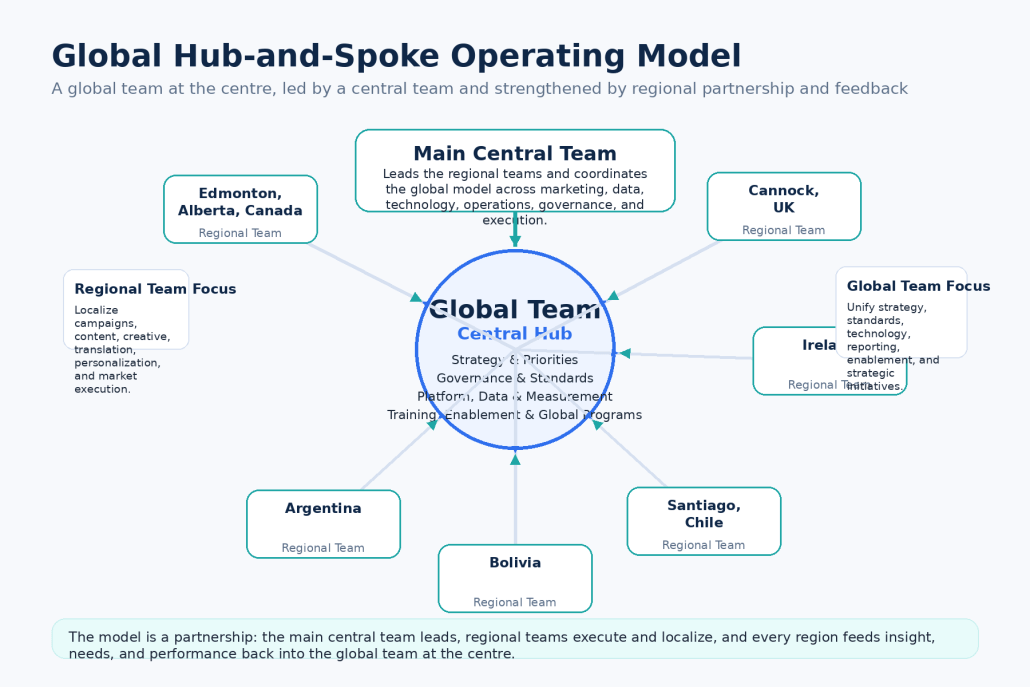
The strategy also defined the need for a first global operating model via a hub-and-spoke model approach between a central team and regional teams.
Central Team Responsibilities
The central team would lead:
- MarTech platform strategy framework + partnered regional leads
- Platform evaluation
- Implementation planning
- Governance
- Change management
- Training and education
- Platform adoption
- Measurement standards
- Global campaign frameworks
- Strategic global sales and marketing initiatives; then ‘lift-and-shift’ these marketing programs to regions for localization.
- Technology sustainment
Regional Team Responsibilities
Regional teams would localize:
- Inform strategy needs and goals.
- Campaign templates
- Creative
- Content
- Translation
- Offers
- Customer journeys
- Personalization
- Regional campaign execution
This model gave the organization the best of both worlds: global standards with local relevance.
Central teams could create the frameworks, governance, and technology foundation. Regional teams could adapt the work to their markets, customers, languages, and sales realities.
Change Management and Adoption
The evaluation made one thing clear: technology alone would not create the return.
The business needed adoption.
That meant the next phase needed to address governance, training, process design, team enablement, measurement, and change management.
And while one region was not fully bought-in from a priority and political POV, the position was to allow other regions to lead by example to demonstrate the art of what’s possible. Soon after the other region jumped on board and accelerated beyond other regions when regional leadership buy-in was finally achieved.
The discovery phase looked at existing team experience, skill levels, workflows, needs, and pain points so the future strategy could support real adoption across regions.
The goal was to help teams use the platform confidently, not just give them access to another tool.
For the investment to deliver value, users needed to understand how to build campaigns, manage data, follow governance rules, use templates, score leads, support sales, read performance data, and continuously improve.
Quick Wins and Long-Term Priorities
The work also separated quick wins from larger transformation priorities using a effort vs. impact matrix organized to key business themes.
This matrix mapped the key activities that were light in effort, and medium to big in impact. Similarily, the larger efforts to drive long-term impact demonstrated where cross-team priorities, budgets and bandwidth were required.
Quick Wins
- Foundational technical requirements.
- Data schema
- User acconts and priveleges
- Campaign templates
- Form standards
- Lead scoring pilot
- Subscription management standards
- Marketable-contact analysis
- Basic nurture journeys
- Data hygiene rules
- Sales handoff process
- Website (Adobe Experience Manager) integration
- Training and enablement sessions
- Governance playbook
Long-Term Priorities
- CRM integration across regions
- Azure data lake integration
- Marketing Data Services Platform and future CDP strategy
- Global lead model
- ABM orchestration
- Attribution model
- Multi-channel Personalization
- Regional adoption model
- Central KPI reporting; Power BI and Tableau reporting
- Long-term platform sustainment and growth
Results and Strategic Outcomes
The engagement gave the organization a clearer path to make a major MarTech capital investment with confidence.
The work delivered:
- A structured global discovery process to make the right ‘business fit’ technology decisions
- Cross-functional stakeholder alignment
- 140+ business user stories
- 8 platform evaluation criteria
- Enterprise vendor comparison
- Cost-of-ownership review
- Business-fit recommendation
- 3-year capital investment model
- ABM and CRM funnel impact logic
- eCommerce and SaaS model impact logic
- Data and integration roadmap
- Adoption and governance considerations
- Phase 2: Stategy development: A foundation to develop the marketing automation strategy and its multi-year execution roadmap aligned to all regions and business units priorities.
Most importantly, the business moved from a vendor-led software decision across Adobe, Oracle and SalesForce to a business-led MarTech strategy.
The platform decision was tied to revenue impact, data readiness, sales alignment, customer experience, regional localization, governance, and long-term adoption.
What Enterprise Leaders Can Learn
Marketing automation should not be evaluated as a standalone tool.
For global enterprises, the right question is not:
Which platform has the most features?
The better question is:
Which platform best fits our business goals and model, data reality, sales process, operating model, regional needs, adoption capacity and our desire to make a operational changes…for the better?
That shift changes the decision.
It helps leaders avoid underused technology. It creates stronger alignment between marketing, sales, data, IT, and regional teams. It also gives the business a better chance of turning MarTech investment into measurable growth.
What’s next?
On two fronts…
I led this brand the acquisition and implementation of the new marketing automation platform (Oracle Eloqua).
In parallel, my team built on the Phase 1 of the marketing automation evaluation to create Phase 2; strategy development and its multi-year roadmap execution.
Phase 2 was a much lighter lift as most the heavy lifting to capture the ‘voice of the business’ was accomplished through Phase 1 and its workshops and user-stories.
Should you pursue a similar goal for your organization and seek guidance or support to help enterprise build a modern marketing strategy and roadmap, or help evaluate the right MarTech and operating model through a business-first lens — contact me to help guide you in your strategy and technology decisions to turn it into a measurable growth engine, and not another tool or unused software.
Let’s map the right growth architecture before your next MarTech or marketing automation decision.