
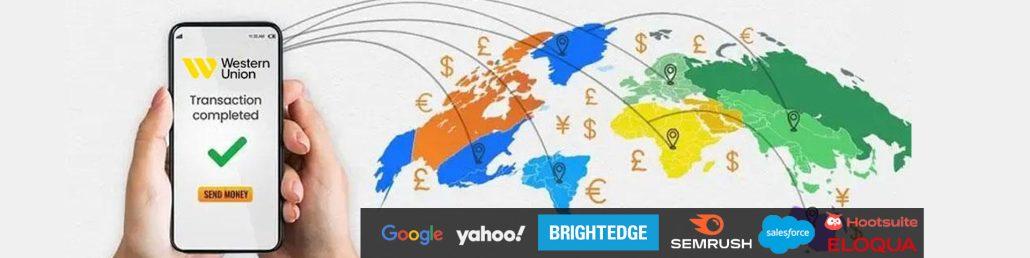
Before AI search reshaped the language of SEO, MJ built the kind of global search, content, and customer-intent foundation that modern digital growth still runs on — helping Western Union Business Solutions turn persona-led content into a B2B demand engine that grew organic traffic by 300%.
Executive Snapshot
This case study shows how persona-led search strategy helped Western Union Business Solutions grow organic traffic by 300% and turn content into a lower-cost demand channel for high-quality inbound sales leads.
As Western Union Business Solutions expanded its B2B payments presence, MJ led the business case, SEO strategy, content operating model, technical foundation, analytics framework, and execution team behind a global search and content growth engine across 70+ localized websites.
The work demonstrates how customer insight, search intent, content governance, technical SEO, analytics, and sales alignment can turn organic search from a marketing activity into a scalable enterprise demand engine.
KPI highlights
- +300% organic traffic lift
Organic channel traffic grew by more than 300%, strengthening the company’s highest-performing and lowest-cost digital acquisition channels. - 550% search share of voice growth
BrightEdge was used to measure search share of voice across priority keyword groups, competitor sets, regional markets, and persona-led search themes. - 165% lift in organic-attributed qualified leads
Search-led content improved lead volume and quality by connecting buyer intent to relevant content, product pathways, forms, and sales follow-up. - 62% lower cost per lead vs. paid channels
Organic search supported a lower-cost acquisition model with longer-term value than paid media alone. - 125 persona-led articles produced
A scalable content engine was built around buyer needs, product utility, search demand, and regional market relevance.
The Situation
Western Union was a global bellwether in money transfer and financial payments, with more than 500,000 locations across over 143 countries.
But Western Union Business Solutions was solving a different growth problem.
The company had entered the B2B international payments space through an acquisition. That created a need to build stronger awareness, trust, and demand with business buyers while also supporting high-net-worth individuals with international payment needs.
The digital footprint was large and complex.
The business operated across more than 70 localized websites across North America, APAC, and EMEA in both international B2B payments, risk management and B2C foreign exchange for high-net worth consumers.
Each market had its own buyer needs, search behavior, legal considerations, language nuances, and regional priorities.
The opportunity was not simply to create more content.
The opportunity was to build a global inbound marketing engine targeting Search and content systems that could increase Search marketing share (share of voice) for brand visibility, capture demand, support sales funnel growth, improve brand metrics, and scale across all regions.
The Problem
Organic search was already proving showing value.
It was among the top-performing channel for sales attribution and one of the lowest-cost sources of qualified demand with little investment put behind it to capitalize on the opportunity cost research showed.
But the business had not yet built the full digital system needed to capture the available search opportunity and its demand in all regional Search markets.
Key gaps included:
- Search demand existed, but content coverage was limited.
- Buyer personas were not fully connected to the customer journey, SEO, content, and lead generation.
- Global websites needed stronger technical SEO, regional structure, and content consistency.
- Search insights were not being fully used across other marketing channels and their investments as digital advertising and broader paid media, social, marketing automation, and sales team adoption.
- Compliance and regional teams needed a governance model that balanced global standards with local flexibility.
- The business needed a clearer financial case for investing in search-led content growth.
MJ built the original business case by quantifying the missed search opportunity.
BrightEdge data, keyword demand, competitive visibility, CPC insights, paid search data, web analytics, and sales attribution signals were used to show the value being left on the table.
The case was clear:
If organic search was already one of the lowest-cost and strongest sales attribution channels, then greater search penetration could unlock a major growth advantage and untapped value.
The Opportunity
Western Union Business Solutions had the brand strength, product utility, global footprint, and buyer need.
What it needed was a stronger digital penetration to tap a major consumer and business demand engine.
The opportunity was to:
- Increase Search share-of-voice across priority topics (align consumer needs to solutions).
- Build persona-led content around real buyer needs.
- Improve organic visibility across global and regional websites.
- Create a website content hub that supported broader online growth in channel strategies of SEO, social media, digital advertising (PPC, Native, Programmatic, Social), sales team adoption, and marketing automation.
- Use Search and website behavior as a signal for buyer intent and interest.
- Improve lead quality through better content journeys with personalized context.
- Reduce reliance on higher CAC / acquisition channels or more blended.
- Build a long-term organic growth asset.
The strategic shift was simple:
Turn search and content from marketing activity into a measurable growth system.
The Solution
MJ led one of Western Union’s first major persona-led Search engine marketing and customer-centric content strategies.
The strategy connected:
Buyer personas → search demand → content architecture → technical SEO → localized websites → lead generation → sales attribution.
The content framework was built around persona needs, goals, pain points, product use cases, and buyer journey behavior.
For example, the strategy could support a business researching international supplier payments or foreign exchange risk mitigation from flucuating rates or an individual looking to make international tuition payments from Canada in CAD to the United Kingdom in GBP.
The strategy had three connected layers.
1. Search and SEO as the core growth engine
SEO was the main focus. The program was designed to grow organic visibility, increase search share of voice, improve search penetration, and create lower-cost demand over time.
2. Content as the demand capture layer
The team produced roughly 125 persona-led articles supported by licensed photography, keyword optimization, semantic language, technical SEO treatment, metadata, internal linking, and content curation across strategic website pages.
3. Paid, social, CRM, and sales as amplification layers
The content was then published in a new ‘content hub’ on its websites, and then curated across social media brand channels, native advertising with Wall Street Journey, NY Times, Business Insider and other major medias, programmatic display across top DSP networks, Google and Bing PPC, marketing automation (Eloqua), SalesForce integration to surface leads and customer accounts content and campaign engagement activity and sales teams enablement.
This kept the strategy focused while still making it integrated across customer channels and Sales teams.
Search and content were the engine. Paid media, social, CRM, and sales were the distribution and conversion layers.
The Operating Model
MJ established and led the central digital growth team responsible for the program.
The model used a global hub-and-spoke structure.
The central team owned:
- Search strategy
- Content strategy playbook
- SEO standards
- Technical SEO requirements and application
- Website management
- Marketing including Search + content performance dashboards
- Website strategy
- Website Analytics (Google Analytics + Adobe Analytics)
- Website tagging
- Governance
- Global execution standards
- Centre of Excellence
Regional leads supported:
- Local market needs
- Regional ‘voice of csutomer’ insights
- Language, terminology and translation
- Legal and privacy nuance
- Local publishing needs
- Regional performance feedback
This helped the business move quickly without losing control.
The direct team included MJ as the digital growth leader, three website developers, a content lead with agency support, an in-house SEO expert guiding the content agencu, a marketing data and web analytics lead, and an external social media agency (Los Angeles) and digital advertising agency (Chicago).
Cross-functional partners included brand, privacy, legal, regional stakeholders, sales, CRM, and marketing automation teams.
Content governance
The team built a repeatable content workflow:
Briefing → writing → editing → SEO optimization → brand review → privacy review → legal review → regional review → publishing → tagging → performance tracking → refresh cycle.
This governance model mattered.
Western Union Business Solutions and its parent Wester Union operated in international financial payments and money transfer. It was also a publicly and highly regulated organization listed across U.S. and international exchanges.
The content process had to move fast, but it also had to protect trust, compliance, privacy, and brand integrity.
Each article was treated for:
- Target keywords
- Secondary keywords
- Semantic search language
- Persona needs
- Product utility
- Internal linking
- Metadata
- Regional relevance
- Legal and privacy review
- Brand review
- Performance tracking
Technical SEO & Localization
The strategy also addressed the technical foundation needed for global SEO.
Across the content hub and regional websites, the team applied international SEO controls including:
- Hreflang treatment
- Regional XML sitemaps
- Search Console management
- Canonical rules
- Duplicate-content controls
- Structured data
- Internal linking
- Mobile-friendly page experiences
- Regional website and product-page optimization
This was critical because content was curated and reused across regions.
Without canonical rules and duplicate-content controls, regional content could compete against itself and weaken the main goal: stronger rankings, greater search share of voice, and better organic visibility.
The website experience also had to work across devices. Responsive and adaptive content capabilities were built into the CMS (open source Composite C1) so users could consume content on desktop, mobile, or tablet based on their preferred journey.
Martech, CRM & Tools
The program used a connected MarTech stack through both process or API / ETL intrations. This incldued Search, content, analytics, advertising, website CMS and CRM (SalesForce) stack, Oracle Eloqua, Hootsuite and more
Tools and systems included:
- BrightEdge
- SEMrush
- Additional keyword research tools
- Paid search keyword and CPC data
- Google Analytics
- Adobe Analytics
- Google Search Console
- Hootsuite (Social media management)
- Oracle Eloqua (marketing automation)
- Regional search console and webmaster tools
- SalesForce app built for UTM tagging standardization
- Web form lead-source tracking
- Salesforce CRM integration
- Google Data Studio, now Looker Studio
- Content performance dashboards
- Marketing performance dashboards
The CMS was open-source and flexible (Composite C1). It supported reusable content blocks (like flexible lego blocks), custom modules, templates, campaign landing pages, and global digital assets.
A prior website centralization effort on the team also helped. It created the foundation for global consistency with regional adoption, allowing teams to manage content, launch campaign pages, and reuse approved assets without rebuilding from scratch.
How Search Powered Other Customer Channels
The SEO and content strategy did not sit in isolation.
Search and content performance data informed:
- PPC campaigns
- Native content advertising
- Programmatic display + retargeting
- Social media content syndication
- Social selling (Sales executives adoption)
- Website personalization (behavioral based)
- Marketing automation (ex. lead qualification and nurture lifecycle programs)
- Sales enablement via SalesForce integration for account-level activity and ABM
The content was curated across Social media brand channels (Facebook, Twitter) and used in native advertising placements with publications including Financial Post and The Wall Street Journal.
Programmatic campaigns were built around brand, persona need, and product utility.
Advertisements were tested through A/B/C variants to understand which messages, topics, and buyer needs created the strongest engagement from click through to conversion.
This made search data more valuable.
Search behavior became a signal for the broader digital growth system.
Marketing Automation & Lead Profiling and Nurturing
Content engagement was also used to improve website visitors and lead profiling, qualification and nurturing.
Visits, clicks, article engagement, search terms, and topic interest helped identify digital behavior signals. Those signals supported more relevant content follow-up, better segmentation, and more tailored nurture journeys.
For example, if a user engaged with content about international tuition payments from Canada to the United Kingdom, the marketing automation strategy could support follow-up content related to CAD-to-GBP transfers, tuition timing, currency risk, and payment options.
Similarily, tracking sales leads interests and engagement into core tools as an online foreign exchange (FX) calculator helped inform both lead score and lead quality (ex. $1K FX transfer vs. $100K FX transfer).
This helped the business move from broad promotion to more personalized buyer journeys and an enriched Customer 360.
Sales Enablement
The content became useful beyond marketing.
Sales teams adopted the articles as relationship-building assets. They used content in account conversations, outbound account follow-ups, education, and nurture tracks.
Sales executive also adopted the content for Social selling via resharing approved content through their own professional channels.
That created a stronger bridge between search visibility, content engagement, digital behavior, and sales conversations.
Results & Impact
The program delivered a major lift in organic performance.
Organic channel traffic increased by more than 300%.
The impact went beyond traffic.
The program helped strengthen organic search as a long-term growth channel.
It improved Search market share over competitors and brand visibility, supported an inbound qualified lead generation engine, reduced reliance on higher-cost paid channels and others when curated, gave sales teams stronger content to use in account development and served cross-functional teams to serve as a new tool in their toolbox in their roles.
On the SEO frontlines, BrightEdge was used to measure search share-of-voice, keyword research and tracking before and after the program across priority keyword groups, competitive visibility, and content themes.
This helped connect the original revenue opportunity research to actual gains in search penetration and demand capture.
The work also gained big attention from corporate head office of Western Union. Corporate teams noted they had been trying to solve a similar challenge for more than six years.
MJ and the team moved from business case to operating model and execution foundation in roughly five months.
The result was not just a SEO and content program.
It was a repeatable global search and content growth system that become a significant shared enterprise asset for all global and regional marketing teams that supported their annual goals, campaigns, KPI’s and targets.
Why this matters now
This was not an AI, AEO, or GEO program. It predated those terms and the technology environment that created them.
But the foundation is highly relevant to how search continues to evolve.
If the same strategy were built today, it would naturally extend into AEO and GEO through answer-ready content structures, stronger FAQ and entity markup, clearer source attribution, citation-worthy expert content, and visibility tracking across both traditional search results and AI-generated answer surfaces.
The language of search has changed.
The principle has not.
Brands still need to be easy to find, easy to understand, and easy to choose.
The Digital lesson
This case study shows the core value behind MJ Digital’s approach today.
Strong digital growth does not come from strategy alone. It does not come from tactical execution alone.
It comes from connecting both.
MJ brought senior business strategy, search expertise, technical understanding, team leadership, and hands-on execution into one operating model.
The work connected business goals, SEO, content, websites, analytics, paid media, CRM, and sales into a measurable growth system.
That is the MJ Digital difference:
Strategy that understands the business. Execution that understands the build. Performance that can be measured.
For enterprise teams or small businesses and brands trying to turn search, content, data, and digital channels into a stronger growth engine, MJ Digital helps connect the strategy to the operating model and execution required to make it perform.
Start with a Digital Growth Architecture review to identify where search demand, content, website performance, analytics, and sales attribution can work harder together; whether for a B2B sales funnel model, or a B2C or D2C eCommerce model.