
Your next customer may already have an advisor. And it isn’t you.
How AI-assisted discovery is changing the relationship between customers and brands before the first interaction even happens.
The Relationship Shift Series: 3 Part Series
Imagine someone shopping for running shoes.
They don’t begin on a retailer’s website. They ask an AI assistant as ChatGPT or Perplexity which shoes suit their running habits, compare brands, discuss comfort and fit, narrow their budget and build a shortlist.
By the time they reach a retailer, much of their research and decision-making has already happened.
The brand may see a product visit or a purchase. But the customer has spent considerable time building confidence somewhere else.
The customer may be developing a relationship with an AI assistant before developing—or deepening—a relationship with the brand.
Part 1 — Digital Isn’t a Channel. It’s a Relationship. Why the relationship matters more than individual touchpoints.
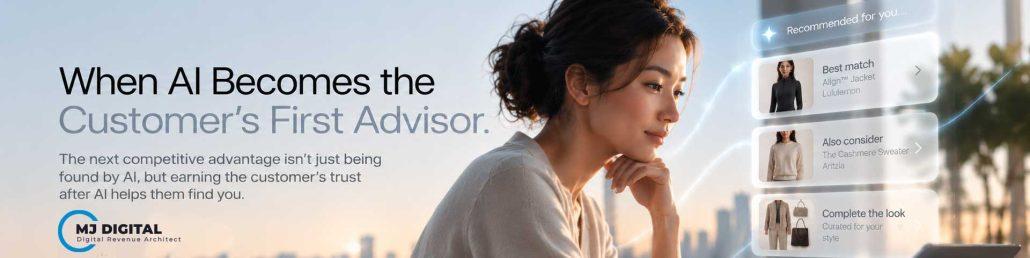
Part 2 — When AI Becomes the Customer’s First Advisor. How AI is changing discovery, intent and trust.
Part 3 — Coming soon: From Customer Data to Relationship Intelligence. How to connect data, decisions and execution.
Search is becoming a conversation
Traditional search often begins with keywords or query, search results and website visits.
Though AI-assisted discovery can unfold as a conversation.
Customers ask questions, challenge recommendations, compare alternatives and refine what they want.
A search for “running shoes” reveals an interest. A conversation about distance, location and terrain, fit, budget and previous experiences can reveal much more about the customer’s needs.
In AEO, GEO, and SEO: Why Search Is Becoming a Visibility Strategy, I explored why brands need to think beyond traditional rankings toward accurate, trustworthy and accessible information that AI-powered discovery systems can understand.
But visibility is only the first challenge.
The larger question is what happens to the customer relationship when an AI assistant influences discovery, recommendations and decisions before the customer engages with the business.
The customer context doesn’t automatically follow
Here’s an important distinction.
When a customer seeks an answer to a question, or researches products through an external AI assistant as Claude, ChatGPT or other, the brand generally cannot see those private conversations.
The business may observe a referral, a website visit or information the customer voluntarily shares. But it shouldn’t assume it knows the full conversation or the customer’s underlying intentions.
That creates both a limitation and an opportunity.
Imagine the customer arrives at your store with a shortlist created through an AI assistant. A knowledgeable store associate can help validate fit, explain differences and offer practical advice.
Take it a step further. Even if an AI assistant could easily access the same product knowledge as a store associate, the business still needs a strong data foundation. A well-structured PIM (product info management solution) should go beyond basic specifications to include fit, complementary accessories, materials, breathability, care instructions, and even more enriched wit it connected to customer feedback for common customer questions, and potential risks from improper care.
But having the right data isn’t the same as delivering the right advice.
That’s where a knowledgeable store associate still adds value—understanding the customer’s specific personal needs, asking the right questions, offering hands-on guidance, and helping them make a confident decision.
AI can make product knowledge more accessible. People can turn that knowledge into a more personal, trusted customer experience.
From there, the customer’s needs and purchase intent will shape how they choose to engage. Some will value the personalized attention and reassurance of a white-glove in-store experience. Others will prefer the convenience of buying online, confident that the business understands their needs and will deliver on its promise.
The real opportunity isn’t to push customers toward one channel, even when lowering cost to serve is a business priority. It’s to build trust through the right level of hyper-personalization, giving customers the confidence to choose your business, wherever and however they prefer to engage and buy.
Or consider a financial institution member who has used AI to understand mortgage options. When they speak with an advisor, they may already have detailed questions and expectations.
The business needs to meet customers in-the-moment in their journey, with the right level of context, rather than assuming discovery starts on its own website.
Turn owned interactions into useful intelligence
The opportunity becomes more tangible when customers engage with brand-owned digital experiences.
A conversational assistant might help someone compare products using reliable inventory, sizing, availability and product information. With appropriate consent, relevant preferences or unresolved questions could support a later interaction with your customer support or an employee.
That context can make the next conversation more useful and memorable without requiring the customer to start over.
It can also help the business learn.
Questions that repeatedly go unanswered may reveal missing product information.
Questions that go answered but never captured and connected into a data strategy, is huge wasted opportunity.
Common objections may inform content or merchandising. Recurring service concerns may identify operational problems, or even individual employee training issues.
In my global SEO and content growth case study, search and content signals helped get discovered and inform buyer understandings with follow-up activity.
And my AI chat and customer intelligence case study explores how conversational interactions and digital signals can support more relevant customer engagement.
The underlying principle is that discovery is becoming both a customer experience and a valuable source of relationship intelligence.
But making this work starts with an honest assessment of your digital ecosystem and data strategy.
It means connecting the pieces of your data puzzle—product, customer, behavioural, inventory, financial, campaign data, and more—and turning siloed and fragmented data and information into intelligence your business can actually use.
That’s what enables hyper-personalized experiences across every customer touchpoint, whether through a frontline employee, a digital channel, or an AI-powered interaction.
The goal isn’t simply to connect more data. It’s to make every customer interaction smarter, more relevant, and more valuable—while building trust, driving growth, and lowering the cost to serve.
What should digital leaders prioritize?
Start with three practical questions.
- Is our product and service information accurate, structured and accessible to the systems customers use for discovery? I would even add is its architecture flexible and easily scalable for further data enrichment?
- When customers engage with our owned experiences, do we understand what they’re trying to accomplish? For example, is the intent of someone browsing an car dealership’s website to buy a new car driven from an upcoming lease expiration, a written-off vehicle accident, new driver buying their first car, new to the city and need a car, etc. What is the driver (no pun intended) of their intent to browse the vehicle inventory on your website?
- And can relevant customer information, shared with their consent (e.g., a customer agreeing to share their AI shopping preferences with a store associate), improve the next interaction—whether with a digital assistant, advisor, or frontline employee?
These questions point to a bigger business challenge: connecting the right data, technology, people and processes so customer intelligence can translate into better experiences.
I’ve explored the operational side of this in Part 2 of my Growth Engine series: Making the Growth Engine Work, including how businesses can build the capabilities and operating model needed to turn connected intelligence into measurable business value.
The objective isn’t to capture every conversation or automate every response.
It’s to make the business easier to discover, easier to understand and more useful when customers choose to engage.
As AI changes the discovery interface, trust will depend increasingly on the quality of information and the experience that follows.
The next challenge isn’t simply being found by AI. It’s earning the customer’s trust after AI helps them find you.
In Part 3 of the Relationship Shift, I’ll explore how your business can connect its data, intelligence, technology, people and operating models to turn these opportunities into real customer experiences and measurable business outcomes.
In the meantime, I’d love to hear your perspective. Are you seeing similar shifts in how customers discover, evaluate and engage with businesses?
Have questions or ideas, or simply curious about where this is heading? Feel free to reach out to me here or connect with me on LinkedIn. I’m always open to exchanging perspectives, challenging ideas, exploring opportunities or having a good conversation about what’s next.